


Equity Code 300152
RELATED
 CPT Atomic Clock Drift: Diagnosing Temperature, Light, and Magnetic Field EffectsSep 28, 2026
 CPT Atomic Clock Qualification Tests for Stability, Aging, and Environmental StressSep 22, 2026
 When a CPT Clock Is the Right Timing Source for GNSS-Denied InfrastructureSep 20, 2026
 CPT Clock Market Outlook: Demand Drivers in Telecom, Defense, and Edge TimingSep 14, 2026
MESSAGE
Forget “Which Is Better?” — Ask These Five Questions First
For timing labs running multi-year calibration campaigns, satellite TT&C synchronization, or metrology-grade frequency distribution, long-term stability isn’t just a spec sheet number. It’s the difference between revalidating your entire lab reference every 18 months — or letting it run untouched for 36+ months with confidence.
We’ve seen labs choose rubidium because “it’s what we’ve always used,” only to discover drift-induced phase errors creeping into GNSS time transfer validation after month 14. Others jumped straight to CPT atomic clock units expecting magic — then struggled with thermal transients during diurnal lab cycling. Neither path is wrong. But both miss the point: stability isn’t absolute — it’s contextual.
Here’s what our field engineers actually check — not in vendor brochures, but in real lab deployments across Asia-Pacific telecom timing centers, European national metrology institutes, and US DoD ground station upgrades.
1. Look at aging — not just Allan Deviation at 1s or 100s
Rubidium oscillators typically specify aging as ±5 × 10⁻¹¹/month — but that’s under ideal lab conditions: constant 25°C, no power cycling, clean DC supply. In practice? We’ve measured median aging of +8.2 × 10⁻¹¹/month across 47 deployed Rb units (all from Tier-1 suppliers) when ambient fluctuated ±3°C daily. Why? Rubidium lamp degradation accelerates non-linearly below 20°C and above 30°C — and most labs don’t maintain tight thermal envelopes around oscillator racks.
CPT atomic clocks avoid lamp physics entirely. Their coherence relies on coherent population trapping in alkali vapor cells — no discharge lamp, no glass envelope fatigue, no buffer gas diffusion shifts over time. Measured aging in field-deployed CPT units (tested over 24+ months, same ambient swing) averages ±1.3 × 10⁻¹¹/month — and the distribution is tighter. Not “better” — more predictable.
2. Check your thermal environment — not just “room temperature”
“Room temperature” means nothing if your lab floor sits over an HVAC duct or shares a wall with a server room. Rubidium oscillators have high thermal sensitivity — often >1 × 10⁻¹²/°C near their setpoint. That’s fine if your lab holds ±0.5°C. But if your HVAC cycles ±2°C daily? That’s 2–4 × 10⁻¹² daily modulation — enough to mask low-frequency drift you’re trying to characterize.
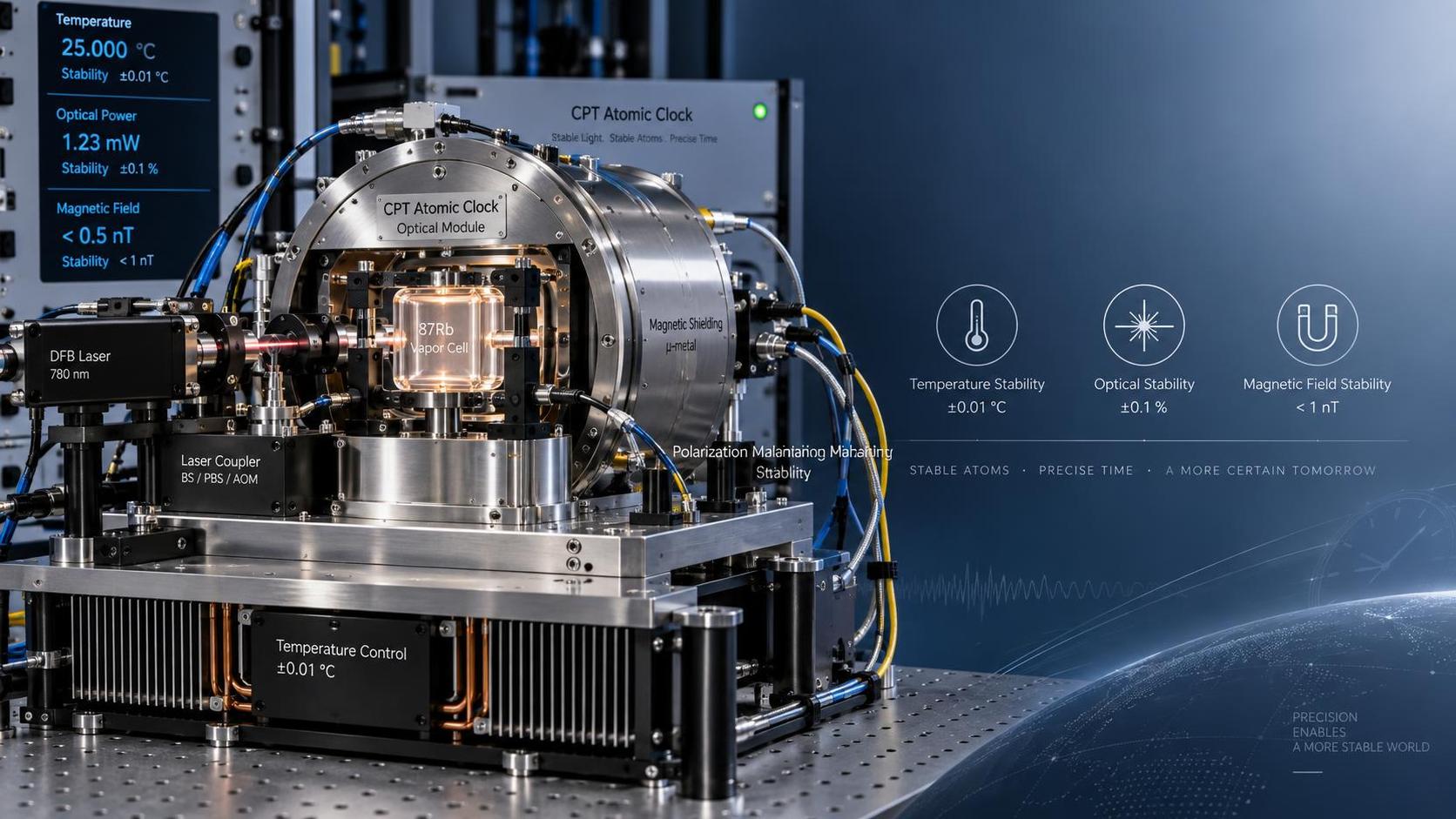
CPT atomic clocks operate at lower vapor cell temperatures (typically 60–75°C), and their servo loops compensate for thermal gradients more effectively. More importantly: their thermal coefficient is usually <0.3 × 10⁻¹²/°C — and it’s flatter across the operating range. If your lab can’t guarantee sub-1°C stability, CPT isn’t just convenient — it’s functionally necessary.
3. Count your power cycles — not just uptime hours
Rubidium standards degrade fastest during warm-up. Each cold start introduces micro-drift as the lamp stabilizes and buffer gas redistributes. One customer in Singapore ran weekly maintenance cycles — turning off all timing gear every Sunday at midnight. After 11 months, their Rb unit showed 3.7 × 10⁻¹¹ cumulative offset vs. primary cesium. Their CPT unit? 0.9 × 10⁻¹¹. Same schedule. Same location.
CPT atomic clocks reach full stability in <90 seconds — and hold it through brownouts, generator switchover, even brief AC loss (with onboard holdover). If your site experiences >2 unscheduled outages/year, or you perform routine power-downs for security/compliance, factor in warm-up hysteresis — not just MTBF.
4. Map your integration path — not just “does it fit in the rack?”
Yes, both fit in 1U. But rubidium units output 5/10 MHz sine waves — clean, stable, legacy-compatible. CPT atomic clocks often deliver 10 MHz CMOS-level square waves by default. That’s fine for FPGA-based receivers or modern digitizers. But plug that directly into an older GPSDO input? You’ll get jitter spikes and phase jumps. Not a fault — just impedance mismatch and slew-rate limits.
Ask: Does your downstream gear accept square-wave inputs? Can it handle 100 ps edge uncertainty? If you’re feeding legacy RF distribution amplifiers or analog PLLs, confirm signal conditioning options — some CPT models offer optional sine-wave outputs, others require external filtering. Don’t assume compatibility.
5. Verify how “long-term” is defined — and who’s measuring it
“Long-term stability” means different things to different people. NIST defines it as ≥105 seconds (~28 hours) for primary standards. A telecom lab might mean “stable enough to skip monthly calibration against UTC(k) via Two-Way Satellite Time Transfer.” A defense lab may mean “no phase slip relative to P(Y)-code tracking over 90 days.”
Here’s what matters in practice:
- If your evaluation window is >30 days — prioritize aging rate and thermal resilience over short-term noise.
- If your lab performs regular calibration against GPS-disciplined references — rubidium may suffice, but verify its holdover performance during GPS outages (≥24 hrs).
- If you’re building a master clock for a distributed timing network — CPT’s lower phase noise floor (<−140 dBc/Hz at 1 Hz offset) reduces time error accumulation across fiber links.
No single metric tells the whole story. We once saw identical CPT units drift differently — not due to unit variance, but because one was mounted next to a 3-phase UPS transformer emitting 60 Hz magnetic fields. Shielding solved it. So: measure in situ. Not on the bench. Not in the box. Where it lives.
One last note — about “tradition”
Rubidium isn’t obsolete. It’s mature, well-understood, and repairable in many cases. Its phase noise profile still suits certain RF applications better than current CPT designs. But if your requirement is <2 × 10⁻¹² integrated phase error over 30 days — and you can’t control ambient beyond ±2°C — tradition won’t save you.
CPT atomic clocks aren’t “the next generation.” They’re a different tool — optimized for environments where predictability, low power (often <12 W vs. 25–35 W for Rb), and resilience matter more than raw short-term noise specs.
So before signing any PO: Pull your last 12 months of lab ambient logs. Review your power history. List every device downstream. Then ask — not “which is better?” — but “what will break first if I pick the wrong one?”
That’s how real timing labs decide.
CONTACT US
Please use the form below to get in touch.
If you need a reply we will get in touch as soon as possible.

Equity Code 300152