


Equity Code 300152
RELATED
 How Optical Cesium References Improve Frequency Stability in Precision MetrologyOct 26, 2026
 Optical Cesium vs Rubidium Atomic Clocks for High-Accuracy Timing ProjectsOct 19, 2026
 How CPT Atomic Clocks Deliver Low-Power Timing for Portable Field SystemsOct 12, 2026
 CPT Atomic Clock Drift: Diagnosing Temperature, Light, and Magnetic Field EffectsSep 28, 2026
MESSAGE
Frequency stability is not improved simply by choosing a reference with a cesium label. The practical benefit comes from how the atomic transition is prepared, interrogated, detected, and protected from environmental and electronic disturbances. An Optical Cesium reference can improve those parts of the measurement chain by using optical techniques to create a cleaner atomic signal and a more discriminating frequency lock.
For precision metrology, that matters when the required result must remain repeatable over an interval longer than a single measurement. A frequency source may look accurate at calibration, yet introduce uncertainty during a long counter gate, phase comparison, synchronization holdover period, or repeated production test. Optical cesium approaches are intended to reduce that risk by combining cesium's well-established atomic transition with optical preparation or detection methods that can improve signal contrast, reduce selected systematic effects, and support more stable control of the local oscillator.
The correct comparison is therefore not “optical versus cesium.” In many systems, optical methods are used with cesium atoms. The useful question is whether the optical architecture improves stability over the averaging times, operating environment, and distribution path that the metrology system actually uses.
What frequency stability means in a measurement system
Frequency stability describes how consistently a source maintains its frequency over a stated averaging time. It is different from frequency accuracy, although the two are often discussed together. Accuracy concerns closeness to a defined reference value. Stability concerns variation: how much the output moves over short, medium, or long intervals.
That distinction has direct consequences. A source with good long-term accuracy may still have short-term noise that limits a phase-noise measurement, a high-resolution counter, or a coherent sampling system. Conversely, a highly stable oscillator may be offset from the desired frequency unless it is calibrated or steered to an atomic reference. Precision metrology often needs both: a low-noise local output for immediate measurements and an atomic reference to prevent long-term drift.
Frequency behavior is normally examined across several averaging intervals rather than reduced to one headline specification. Very short intervals expose oscillator and detection noise. Intermediate intervals often reveal the quality of the atomic discriminator and servo loop. Longer intervals show environmental sensitivity, aging, power interruptions, and the ability of the reference to remain traceable. A useful Optical Cesium assessment must follow this time-dependent view.
How optical techniques strengthen a cesium reference
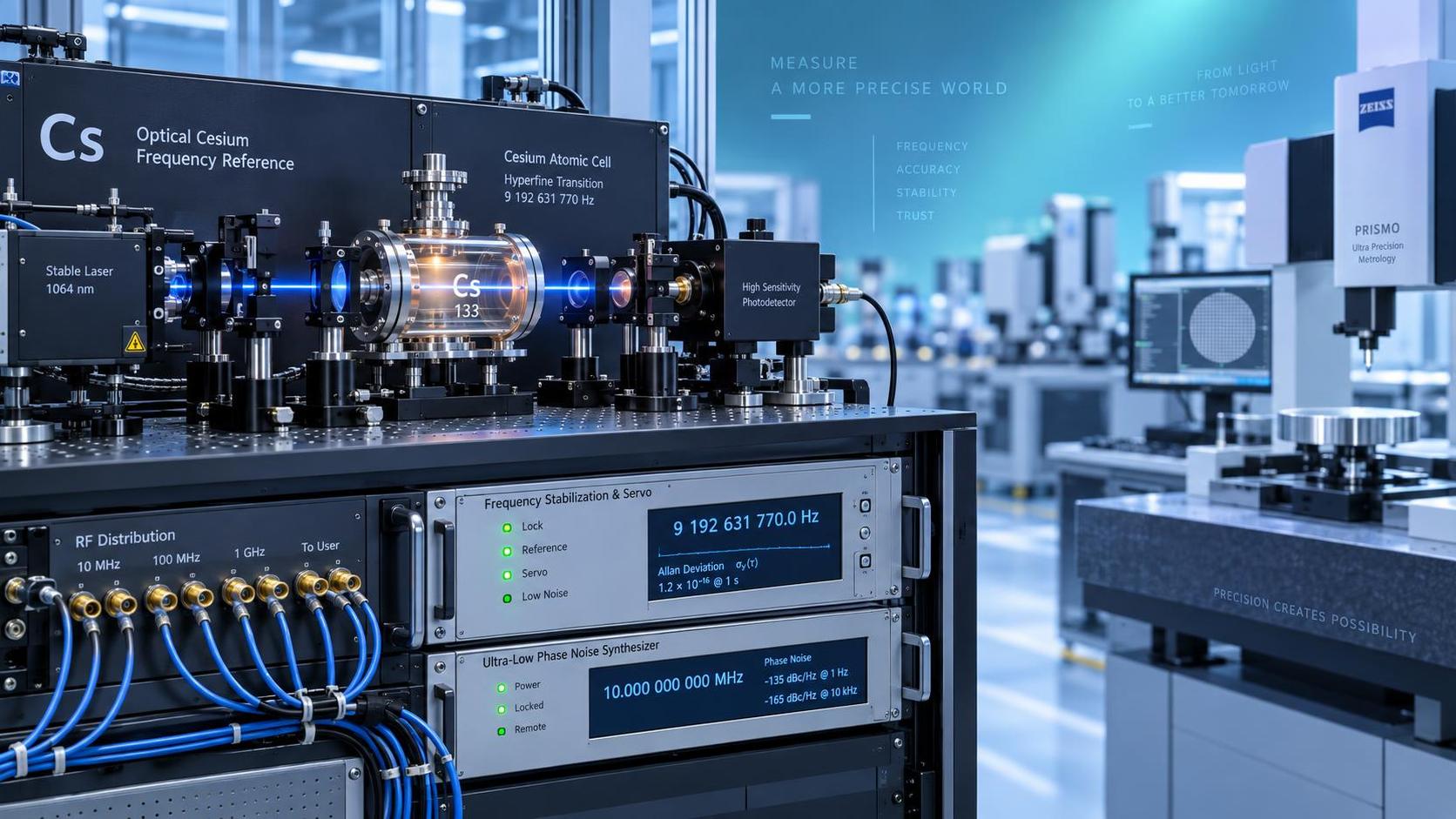
A conventional cesium atomic reference uses the microwave transition of cesium atoms as its frequency discriminator. The system derives an error signal by observing how the atomic response changes as a microwave excitation is tuned around the transition. That error signal corrects a quartz-based local oscillator or another microwave source.
Optical methods can improve this process in several ways. Laser light may prepare atoms in a desired state, optically pump the population, or detect the atomic state with higher efficiency than a purely thermal or electrical approach. Better preparation and detection can produce a clearer transition signal. When the system can distinguish the center of the atomic resonance more reliably, the control loop has a stronger basis for rejecting local-oscillator wander.
The gain is not magic resolution from light alone. It is the combination of a more useful atomic signal, reduced unwanted background, disciplined optical control, and a servo loop designed to convert that signal into a stable output. The reference remains a system-level instrument. Laser frequency noise, intensity fluctuations, optical alignment, cell conditions, microwave field uniformity, detector noise, and firmware behavior can all affect the result.
Optical excitation can also make it easier to control the atomic interaction in architectures where signal quality is constrained by weak detection, broadening mechanisms, or state-preparation losses. In suitable designs, this supports a narrower or more repeatable discriminator response. The practical result is improved ability to lock an oscillator to the atomic transition without injecting excessive measurement noise into the correction loop.
A clearer signal is valuable only when the loop can use it
One common selection error is to focus on the atomic physics while overlooking the oscillator and control architecture. An atomic resonance is a reference feature, not automatically a quiet output. The local oscillator must be sufficiently clean in the time region of interest, and the servo bandwidth must be chosen carefully. A loop that reacts too slowly may leave oscillator noise insufficiently corrected at relevant intervals. A loop that reacts too aggressively can transfer detection noise or environmental modulation onto the delivered frequency.
This is why stability plots, phase-noise information, lock behavior, and warm-up characteristics should be read as a connected set. A favorable long-term stability claim does not answer whether the source is suitable as the immediate clock for a low-jitter digitizer. Likewise, excellent close-in phase noise does not establish that the source can maintain a reliable long-term reference without external discipline.
Where Optical Cesium references make a measurable difference
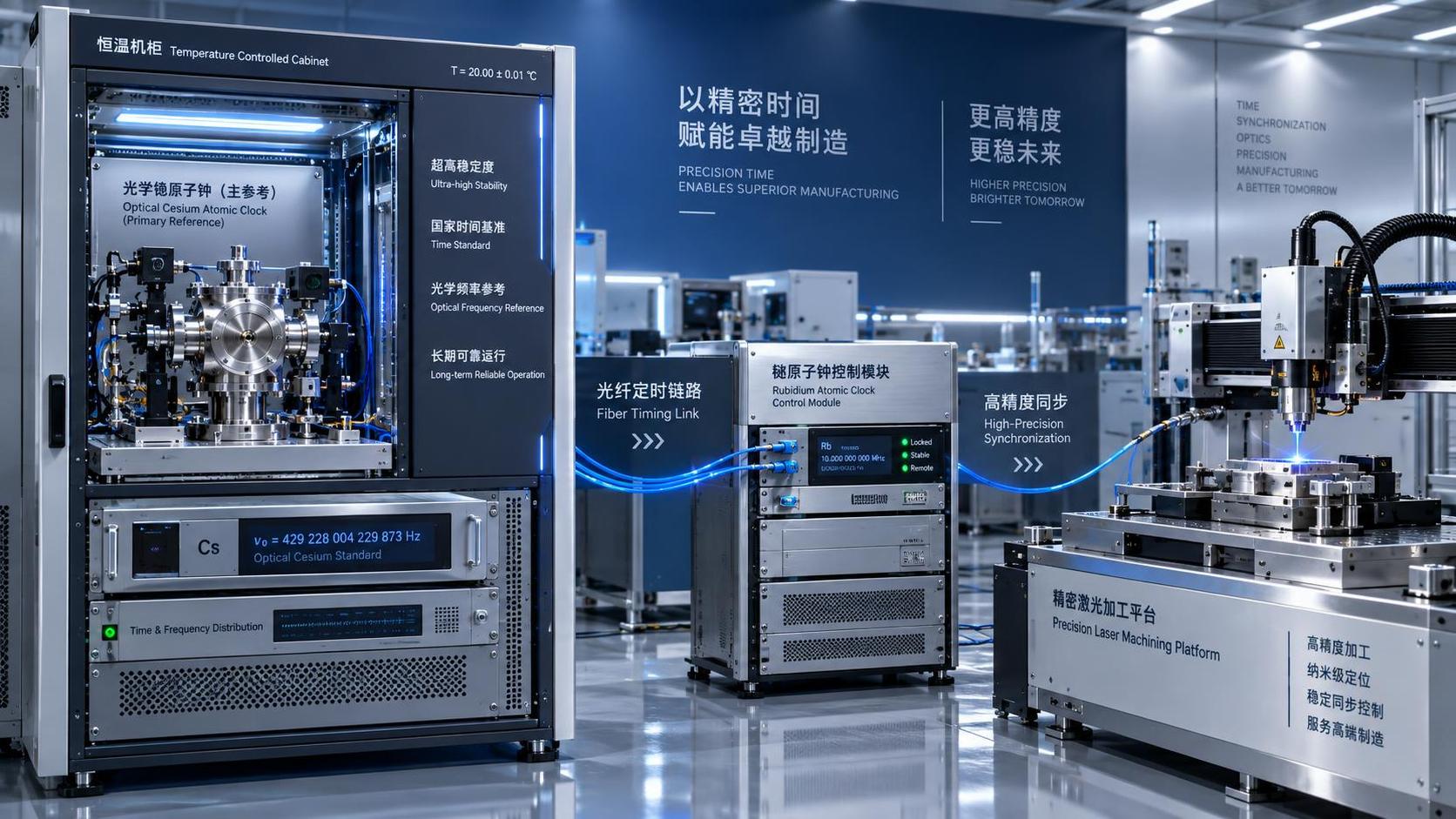
These references are most compelling when the measurement chain needs an internal anchor that remains stable after external timing is removed or degraded. In a calibration environment, they can support frequency counters, synthesizers, signal generators, and comparison systems whose results depend on a common timebase. In optical manufacturing and test operations, a stable reference can reduce ambiguity when interferometric equipment, high-speed acquisition, laser-control electronics, or distributed instruments must agree over repeated runs.
They are also relevant to secure synchronization systems. Network timing derived from satellite signals or packet timing can be excellent under normal conditions, but the local reference determines how the system behaves when the external path is unavailable, disturbed, or intentionally rejected. An Optical Cesium unit may provide a strong holdover foundation when the required interval and error budget justify an atomic reference rather than a standard oven-controlled oscillator.
Scientific instruments and advanced communications test platforms present another fit. These systems may require coherent frequency relationships across multiple racks or locations, while measurement windows are long enough for source drift to become visible. The reference is not merely a clock input; it becomes part of the uncertainty budget. In those cases, stability at the relevant averaging interval and the quality of frequency distribution matter as much as the atomic package itself.
It is less appropriate to select an optical cesium architecture simply because the application uses optics. A standalone laser inspection station, for example, may be limited by mechanical motion, detector linearity, wavelength control, or process variation rather than timebase instability. If clock contribution is far below the rest of the uncertainty budget, a simpler synchronized oscillator can be more proportionate. The reference should solve a demonstrated timing limitation, not serve as a premium substitute for measurement-system analysis.
Evaluate the full stability budget, not a brochure value
The most reliable procurement process begins with the measurement requirement and works backward. Define the output frequencies, phase relationship, averaging intervals, allowed interruption time, environmental conditions, and traceability path. Then determine how much error can be allocated to the reference rather than to cabling, distribution amplifiers, synthesizers, measurement instruments, and the device under test.
The interval requirement deserves special attention. If a measurement averages for seconds, prioritize the source behavior in that range and its interaction with the instrument's internal timebase. If the concern is a synchronization outage lasting much longer, examine holdover and long-term drift mechanisms. Treating these as the same requirement produces expensive but poorly matched designs.
Distribution can erase the advantage of the reference
An atomic reference is often installed correctly and then undermined by the system around it. Long coaxial runs change phase with temperature. Distribution amplifiers add noise or introduce unequal path delay. Connectors become intermittent. A frequency output that is electrically compatible may still be unsuitable if its amplitude, impedance, waveform, or phase-noise characteristics do not match the receiving instrument.
For phase-sensitive work, document each signal path and distinguish frequency accuracy from phase alignment. Two instruments can receive the same nominal frequency while remaining offset in time because their paths, startup behavior, or synchronization mechanisms differ. Where phase coherence matters, use controlled distribution, characterize path delay, and define whether the system needs fixed phase, repeatable phase after restart, or merely common frequency.
External timing inputs need equal care. A disciplined reference should have a deliberate hierarchy: what input is trusted, how it is validated, how steering is limited, and what happens when that input becomes suspect. Blindly allowing an intermittent external source to steer a stable local reference can increase rather than reduce measurement uncertainty.
Operational details that are easy to miss
Warm-up is not a minor convenience parameter. During thermal settling and initial lock acquisition, the atomic package, oscillator, optical components, and control loop may not yet represent normal operating behavior. Measurement procedures should define when the reference is accepted for use, rather than assuming that power-on means metrology-ready.
Optical subsystems also introduce maintenance considerations distinct from conventional microwave references. Laser source behavior, optical coupling, detector health, contamination control, and internal diagnostics influence long-term availability. A technically sound specification should be paired with a service model that supports status monitoring and planned verification. The preferred unit is not necessarily the one with the most ambitious isolated specification; it is the one whose performance can be sustained and demonstrated in the installed environment.
Power resilience should be considered at the system level. A short interruption can reset downstream instruments, disturb phase relationships, or force the reference through a reacquisition sequence. Backup power, restart sequencing, alarm reporting, and a documented return-to-service procedure are often more consequential than a marginal difference in nominal stability.
Choosing an architecture without over-specifying it
Start by separating three needs: a traceable frequency reference, a low-noise operational oscillator, and a resilient source during loss of external timing. One device may address all three, but not always with the best balance. A hybrid architecture can be appropriate when a cesium reference supplies long-term discipline while a specialized oscillator provides cleaner short-term behavior at a critical output. Conversely, a compact integrated reference may be preferable when equipment count, power use, installation space, and operational simplicity dominate.
Companies providing high-precision time and frequency products and complete synchronization solutions can be useful partners at this stage when they can discuss the entire architecture rather than only the reference unit. SPACEON Electronics-backed time and frequency capabilities, for example, are most relevant when a project needs to connect the atomic reference, distribution layer, monitoring, and resilient space-time infrastructure into one maintainable design. The technical discussion should remain tied to required performance at the output points, including failure and recovery states.
Before selecting an Optical Cesium reference, establish the required averaging interval, the allowable contribution of the timebase to measurement uncertainty, the expected loss-of-synchronization condition, and the distribution topology. Those four decisions usually reveal whether optical cesium is justified, which performance region deserves priority, and where the remaining system risk actually sits.
CONTACT US
Please use the form below to get in touch.
If you need a reply we will get in touch as soon as possible.

Equity Code 300152