


Equity Code 300152
RELATED
 Rubidium Atomic Clock Total Cost: Lifetime, Calibration, and Replacement RisksNov 09, 2026
 How Optical Cesium References Improve Frequency Stability in Precision MetrologyOct 26, 2026
 Optical Cesium vs Rubidium Atomic Clocks for High-Accuracy Timing ProjectsOct 19, 2026
 How CPT Atomic Clocks Deliver Low-Power Timing for Portable Field SystemsOct 12, 2026
MESSAGE
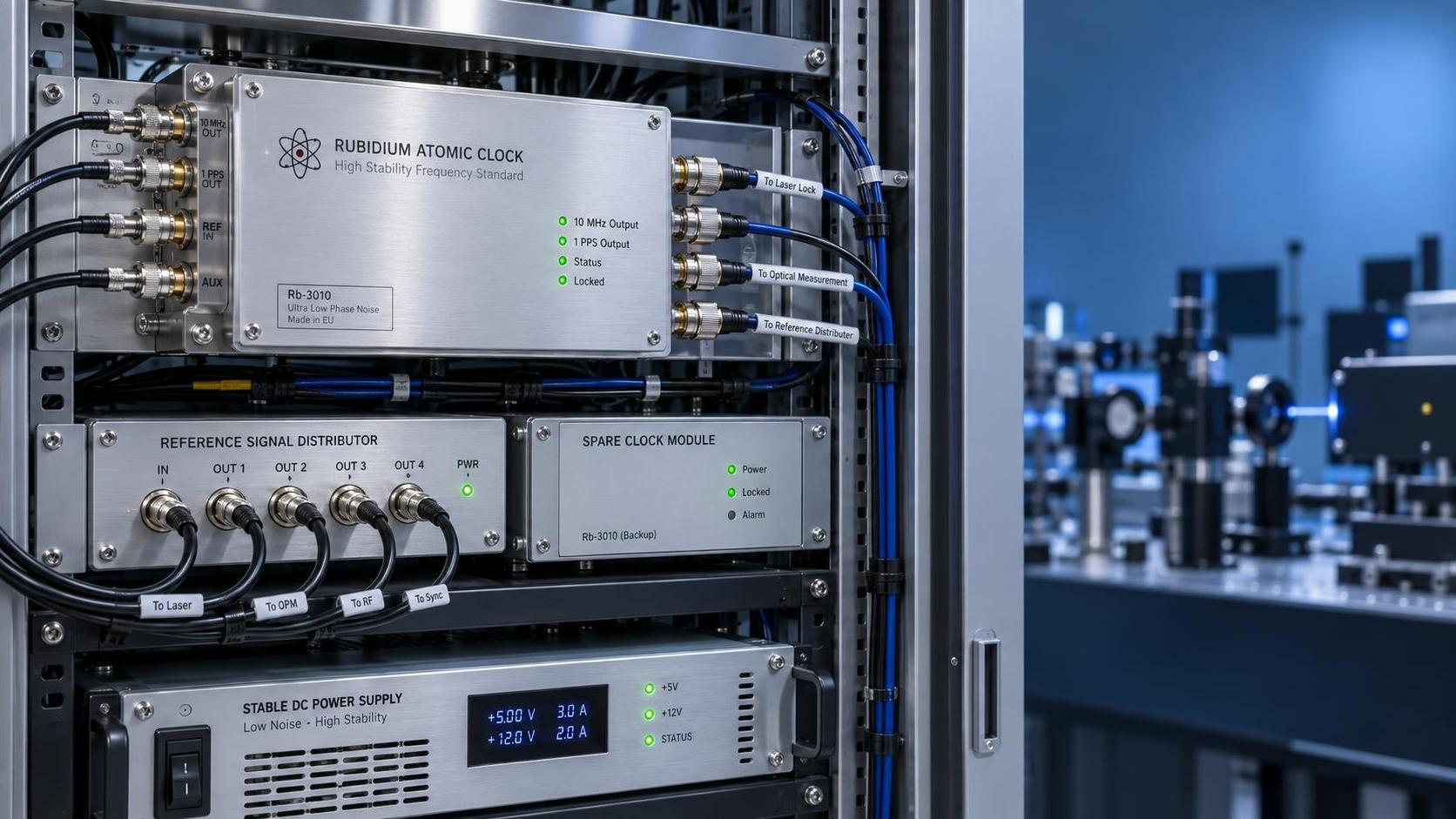
The purchase price is only the visible portion of timing-system cost. A unit with a low initial quotation can become the expensive choice if its drift behavior forces frequent verification, its electrical interface complicates replacement, or its expected operating life does not match the service horizon of the instrument it supports. For a Rubidium atomic clock, the useful cost model begins with the required holdover performance and ends with the practical consequences of taking the unit out of service.
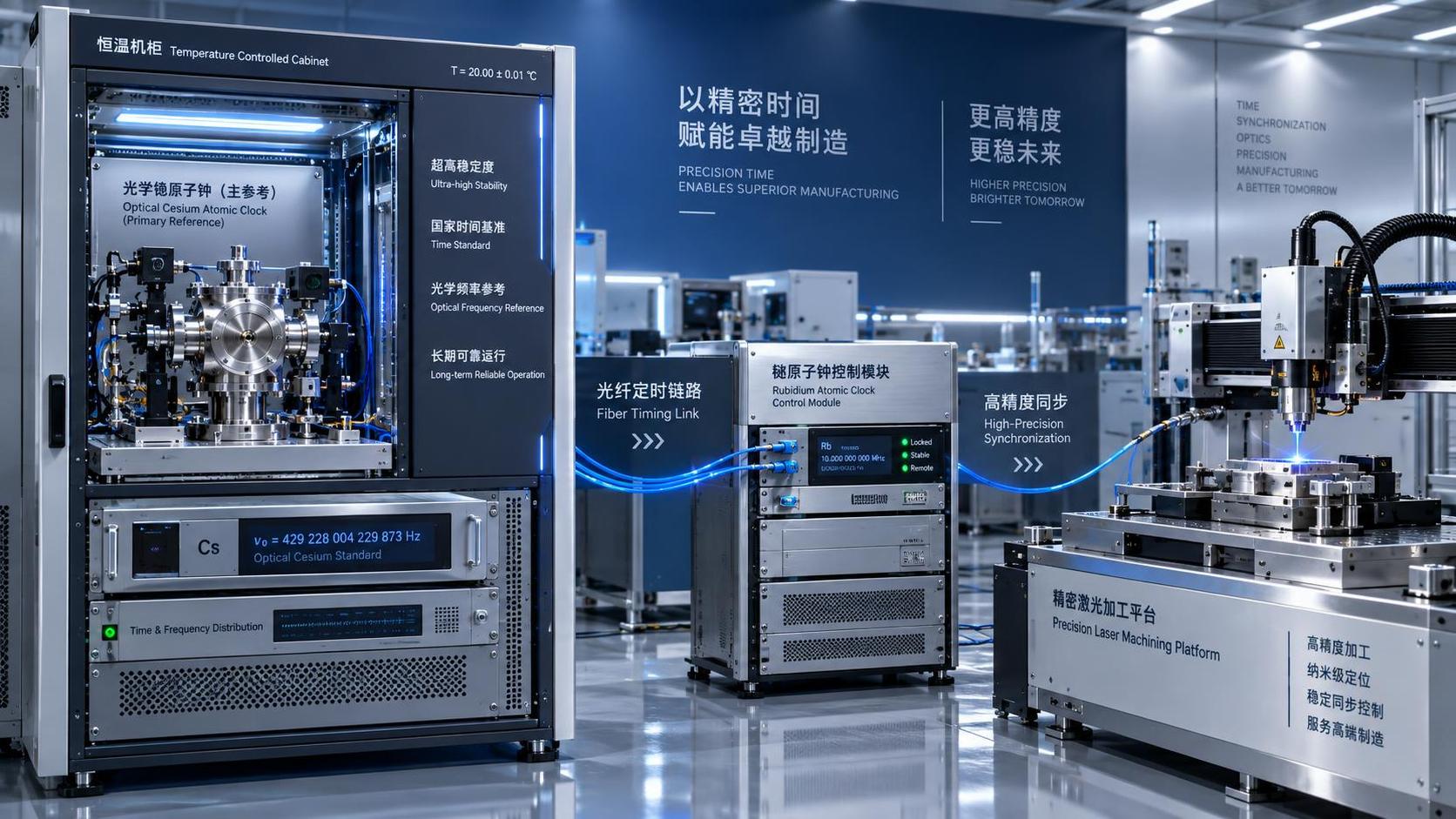
This is especially relevant where timing supports optical manufacturing equipment, laser control, frequency synthesis, test benches, synchronization networks, or measurement systems that cannot simply accept a different reference without validation. A frequency reference is often physically small, yet it can sit inside a chain whose alignment, software settings, signal distribution, and acceptance records all depend on its behavior.
Start with the cost of timing error
Lifetime value cannot be judged from a stability specification alone. The first question is what occurs when the external timing source disappears, degrades, or is intentionally disconnected. The answer depends on the allowable phase error over the expected holdover interval, not merely on a headline frequency stability figure.
A source that performs well over short averaging times may still accumulate enough offset over days or weeks to affect a synchronization budget. Conversely, an application that restores its external reference within minutes may receive little economic benefit from paying for exceptionally long holdover. The relevant comparison is between the reference's aging and environmental sensitivity and the time available before the connected system must be resynchronized.
Cost consequences differ sharply by application. In a laboratory instrument, a moderate frequency offset may only require a repeated measurement. In an optical production cell, an unscheduled timing fault can interrupt process qualification, invalidate traceability records, or trigger rework while the cause is isolated. The cost model should therefore assign a value to the permitted outage window and to the time needed to prove that normal operation has been restored.
Read the specifications as a connected set
Short-term stability, aging rate, warm-up behavior, retrace after power interruption, phase noise, and temperature dependence describe different parts of performance. Treating any one of them as a substitute for the others creates false equivalence between references.
For example, excellent short-term stability supports low-noise synthesis and measurement, but it does not establish long-term accuracy without reference to aging and calibration history. A stated aging value also needs context: it may describe behavior under a particular operating condition or an early-life period rather than a guaranteed straight-line trend for every installed unit. Aging is not always monotonic. Settling, environmental exposure, power cycling, and prior operating history can change the observed correction pattern.
Warm-up requirements deserve the same attention. When a reference is continuously energized in a controlled cabinet, warm-up may have almost no operational cost. When equipment is routinely switched off, moved between stations, or powered through a shared restart sequence, the delay before its output is within the intended performance range becomes part of the production schedule. A technically acceptable reference can still be operationally unsuitable if the system is expected to be ready immediately after power restoration.
Service life is an operating assumption, not a calendar label
Rubidium references rely on a physics package, lamp or optical pumping arrangement, resonator, electronics, and control loops. Their service life is affected by more than elapsed time. Continuous operation, repeated thermal cycling, supply quality, enclosure temperature, vibration, and nearby electromagnetic interference can influence the rate at which performance changes or the likelihood of a fault.
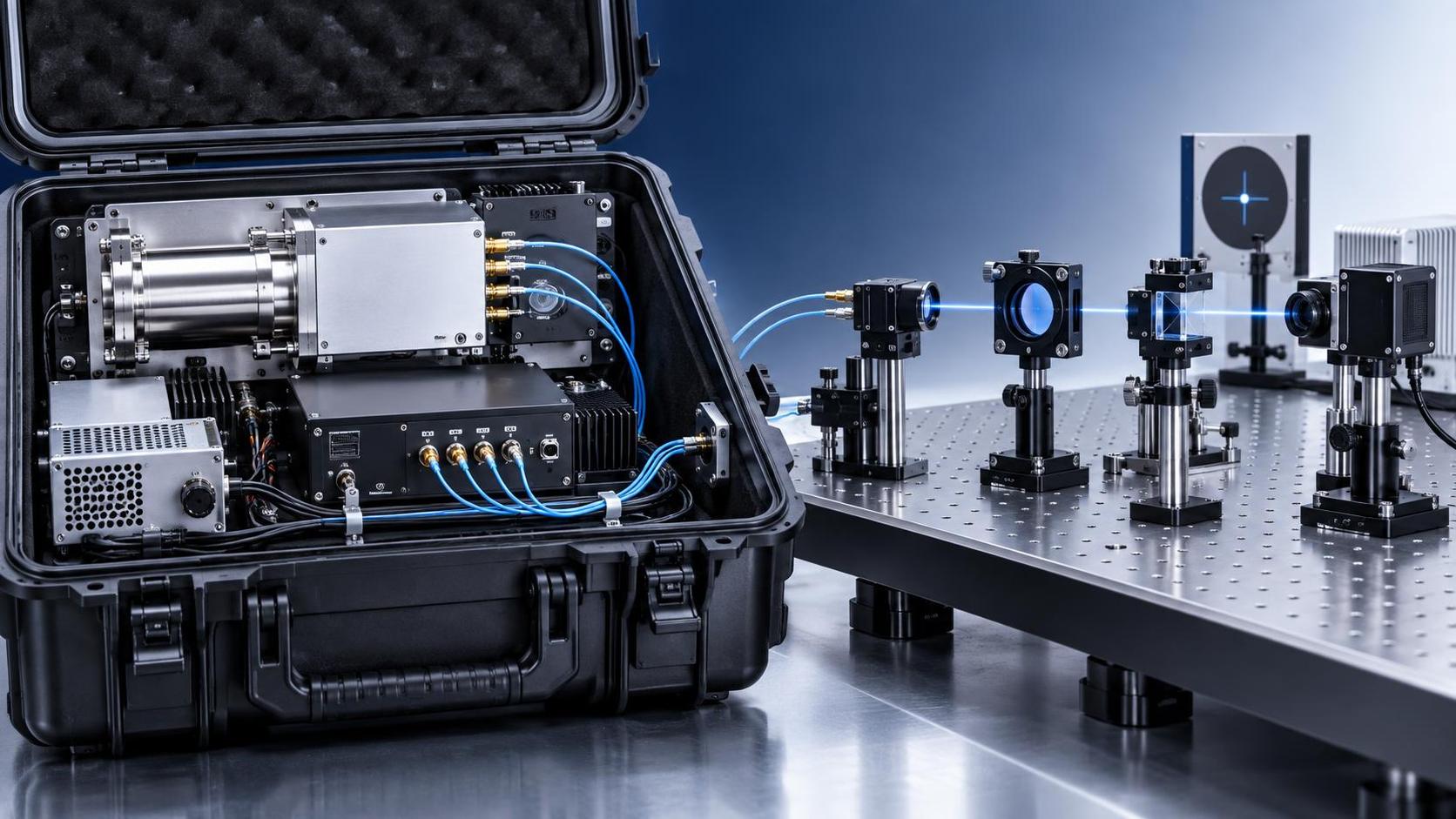
A controlled equipment rack and a portable field enclosure impose different burdens. High ambient temperature raises the internal thermal load and can shorten the practical margin of associated power components. Repeated starts expose the unit to different stresses than uninterrupted operation. An unstable DC supply may create symptoms that look like reference degradation even though the reference itself is healthy. Before classifying a clock as end-of-life, technicians should separate output instability caused by power, grounding, connector condition, distribution amplifiers, or external locking circuitry from intrinsic frequency behavior.
The economically important lifetime is the period during which the unit remains suitable for its assigned role with reasonable verification effort. That period may end before a hard failure. A reference installed in a low-criticality monitoring role can remain useful after its correction trend becomes inconvenient for a precision control loop. The same behavior may require replacement in a system with a narrow timing budget.
Calibration cost is driven by uncertainty and access
Calibration is often described as a recurring line item, but its actual burden has several layers. The direct charge for a measurement is only one part. Removing a module from a timing chain can require a maintenance window, a temporary reference, controlled shipping, reinstallation, and a functional check of the connected equipment. Where the reference is integrated into an optical instrument, access may involve opening a shielded enclosure or restoring cable routing that affects signal integrity.
The calibration interval should arise from the allowable uncertainty at the end of the interval. This requires combining the reference's observed drift, the uncertainty of the comparison method, environmental contributions, and the application's remaining tolerance. A fixed annual schedule can be appropriate for an established installation with stable historical data. It is less defensible when the unit has recently been relocated, exposed to abnormal temperature, or placed into a more demanding role.
Historical correction records are more valuable than a single pass/fail certificate. A series of measurements reveals whether the frequency offset is stable, smoothly changing, or erratic. Smooth behavior may support a planned correction strategy where the system architecture permits it. Irregular changes call for investigation because they can reflect environmental effects, oscillator-control problems, intermittent locking behavior, or measurement setup errors. Extending an interval simply because the last result was within tolerance ignores the direction and repeatability of the trend.
Calibration method also matters. Comparing against a suitable traceable reference at the point of use captures errors introduced by distribution cables, buffers, connectors, and signal conversion. Sending only the module to a laboratory isolates the device more cleanly but may leave installation-related errors unobserved. Neither approach is universally superior. The useful choice follows the uncertainty budget and the cost of removing the equipment from service.
Shipping can alter both cost and confidence
A removable unit needs packaging that protects it from shock, electrostatic damage, moisture, and connector damage. Temperature exposure during transport can also affect the time required for stabilization after arrival. The return process should include serial-number control, recorded pre-removal settings, the state of external lock inputs, output amplitude configuration, and the installed firmware or command profile where applicable.
Without that record, a post-calibration discrepancy may be assigned incorrectly to the reference rather than to an altered installation condition. The resulting investigation can consume more time than the calibration itself. A temporary replacement is useful only when it provides the required outputs and when its behavior is documented well enough to keep the timing chain within its allocated uncertainty.
Replacement risk is usually an integration problem
End-of-life planning should not assume that the next available module is a drop-in equivalent. Two references with the same nominal output frequency can differ in sine-wave or logic-level format, amplitude range, connector geometry, input impedance, lock indication, alarm behavior, current draw, warm-up profile, and control commands. A replacement may physically fit while creating a signal-level mismatch at a distribution amplifier or a timing card.
Software dependence is easier to miss. Monitoring systems may interpret alarm pins, serial messages, status registers, or lock indicators in a vendor-specific way. An updated module can present a healthy output while a supervisory controller reads an unfamiliar status code and places the larger system in a fault state. These interfaces should be documented before a failure forces an urgent substitution.
Qualification effort should be included in the replacement reserve. That effort can include output-frequency verification, phase comparison against the existing source, warm-up observation, holdover testing where feasible, alarm-path testing, and confirmation that downstream equipment recognizes the signal correctly. Systems connected to laser frequency control or optical measurement equipment may also require a functional performance check after timing hardware changes, even when the new reference meets its individual specification.
- A spare held in the same environmental conditions as the installed unit can reduce recovery time, but it still needs periodic power-up and output verification. An untested spare is inventory, not demonstrated redundancy.
- Keeping a reference of the same model simplifies mechanical and electrical replacement, yet it does not eliminate the need to record its independent calibration status and aging history.
- A qualified alternate design is useful when model continuity is uncertain, provided adapter cables, mounting details, configuration files, and acceptance criteria are prepared before an outage.
Power consumption belongs in the lifetime calculation
The direct energy expense of one timing module may be modest, but power behavior affects total system design. A reference with higher steady-state consumption adds heat to a sealed enclosure, which can increase fan use, alter internal temperature gradients, and reduce margin for adjacent electronics. In tightly packed optical equipment, heat management can also affect detector electronics, laser-driver stability, or other temperature-sensitive assemblies.
Startup current and supply tolerance deserve attention alongside nominal watts. A shared supply that handles normal operation but dips during simultaneous restart can produce intermittent failures that are difficult to reproduce. Battery-backed applications require a different calculation: holdover duration must include the complete timing chain, not only the reference module. A low-power reference can reduce battery capacity requirements, but only if its warm-up and accuracy behavior remain compatible with the recovery sequence.
Build the commercial comparison around service events
A useful quotation comparison separates acquisition from foreseeable events: commissioning, calibration or verification, temporary-reference coverage, removal and reinstallation, failure diagnosis, shipping, replacement qualification, and final disposal or return handling. This avoids assigning all future uncertainty to a vague maintenance allowance.
The strongest evidence comes from documents that connect the device to the installed system: output and input definitions, environmental limits, warm-up conditions, aging characterization, calibration capability, repair path, service-life assumptions, interface-control details, and change-notification terms for hardware or firmware. A generic datasheet rarely answers every integration question. Clarifications should be recorded in the technical file while the equipment design is still accessible.
There is no single lowest-cost lifetime profile. A continuously operated, temperature-controlled synchronization rack may favor long installed life and a stable verification trend. A mobile or intermittently powered instrument may place greater value on startup behavior, low power, mechanical robustness, and fast replacement. The appropriate cost decision follows the timing error that the system can tolerate, the disruption it can absorb, and the evidence available to validate performance after every service event.
CONTACT US
Please use the form below to get in touch.
If you need a reply we will get in touch as soon as possible.

Equity Code 300152