




CPT Atomic Clock Qualification Tests for Stability, Aging, and Environmental Stress
For quality-control and safety teams, CPT atomic clock qualification is essential to verifying dependable timing under real-world operating conditions across demanding equipment and infrastructure deployments.
Stability, aging, and environmental stress testing expose performance changes caused by temperature shifts, vibration, power variation, electromagnetic exposure, and sustained operation over the intended lifecycle.
A qualified clock is not simply accurate at shipment. It must retain predictable timing behavior, recover safely from disturbances, and provide evidence supporting release and safety decisions.
What Quality and Safety Teams Need to Prove
The central qualification question is whether the CPT atomic clock will remain within specified frequency, timing, power, and safety limits during normal and abnormal operating conditions.
For optical manufacturing equipment, unstable timing can affect synchronization, measurement repeatability, process control, communications, and traceability across multiple production stations and inspection systems.
Quality teams therefore need more than a typical performance figure. They need documented limits, test methods, acceptance criteria, sample records, and failure-response procedures.
Safety personnel need assurance that timing degradation will not create unsafe states, misleading logs, incorrect interlocks, or silent synchronization failures in critical connected systems.
A practical qualification program distinguishes temporary frequency shifts from permanent damage. Both matter, but they require different controls, corrective actions, and lifecycle risk assessments.
Temporary deviation may be acceptable when recovery is fast and measurable. Permanent drift, unexpected reset behavior, or loss of output integrity usually requires deeper investigation.
The qualification plan should link every test to a real operating risk. Testing without defined use conditions can produce data but still leave important deployment gaps.
Before testing begins, teams should define the clock's role, required holdover duration, synchronization architecture, environmental envelope, maintenance model, and consequences of timing loss.
Start With Measurable Stability Requirements
Frequency stability determines how consistently a CPT atomic clock maintains its output over specified averaging intervals, directly influencing synchronization quality and system timing uncertainty.
Short-term stability is commonly evaluated using Allan deviation or related measures. It shows noise behavior across intervals relevant to control loops, measurements, and communication timing.
Longer averaging intervals reveal slower effects, including thermal sensitivity, control-loop behavior, environmental variation, and early signs of drift that short tests may miss.
Acceptance criteria should identify the averaging times that matter operationally. A strong one-second result does not automatically guarantee suitable performance over hours or days.
For example, equipment with rapid synchronization updates may emphasize short-term stability, while autonomous holdover applications require stronger confidence in medium-term and long-term behavior.
Use a measurement reference with substantially better uncertainty than the device under test. Reference limitations must be included in the reported measurement uncertainty budget.
Record warm-up time before every stability run. CPT atomic clock performance can change substantially while optical, thermal, electronic, and control components reach equilibrium.
Stability reports should include configuration, supply voltage, ambient conditions, output type, averaging periods, instrument traceability, data-processing method, and any excluded data with justification.
How to Test Frequency Accuracy and Holdover
Accuracy testing confirms the frequency offset of the clock against a traceable reference under stated conditions. It establishes the baseline from which later changes are evaluated.
Measure frequency offset after the specified warm-up period, then repeat testing across representative units. A single passing sample cannot establish reliable manufacturing consistency.
Holdover testing evaluates clock behavior after removal of an external synchronization source. This is particularly important where network interruptions could affect production or safety monitoring.
The test should simulate realistic loss scenarios, including short interruptions, extended outages, repeated reconnection events, and degraded reference quality rather than only clean disconnection.
Track accumulated time error during holdover, not only frequency offset. System users experience timing error, and its growth rate is often easier to assess operationally.
Define what the product must do when holdover limits are exceeded. Useful controls include alarms, status outputs, fault logging, controlled fallback modes, and protection of critical processes.
Recovery is equally important. Verify that the CPT atomic clock reacquires synchronization within specified time limits without overshoot, output discontinuities, or misleading valid-status signals.
For safety-relevant applications, validate failure indication independently. A clock should not report healthy synchronization merely because an output signal remains electrically present.
Why Aging Tests Must Go Beyond a Simple Drift Estimate
Aging describes the long-term frequency change of a CPT atomic clock under continued operation. It is influenced by component behavior, operating temperature, stress history, and control conditions.
Initial aging may differ from later-life aging. Qualification should therefore include sufficient run time to detect early settling effects rather than extrapolating from a brief measurement.
Continuous operation tests should monitor frequency offset, stability, power consumption, lock status, internal alarms, output amplitude, and restart events throughout the evaluation period.
Trend analysis is more valuable than isolated measurements. Plotting results against elapsed operating time helps teams identify linear drift, step changes, periodic effects, and abnormal excursions.
Use statistically meaningful sampling where production volume and risk justify it. Include units from different lots, component batches, assembly lines, and supplier sources when possible.
Accelerated aging can support development decisions, but it should not replace realistic operating-life evidence without a defensible acceleration model and documented correlation to field conditions.
After aging exposure, repeat key baseline tests. Comparing pre-test and post-test stability, accuracy, power, and output behavior reveals whether degradation is reversible or permanent.
Qualification records should define the maximum permitted aging rate and the expected recalibration interval. This turns laboratory data into an actionable maintenance and replacement strategy.
Environmental Stress Tests That Reveal Real Deployment Risk
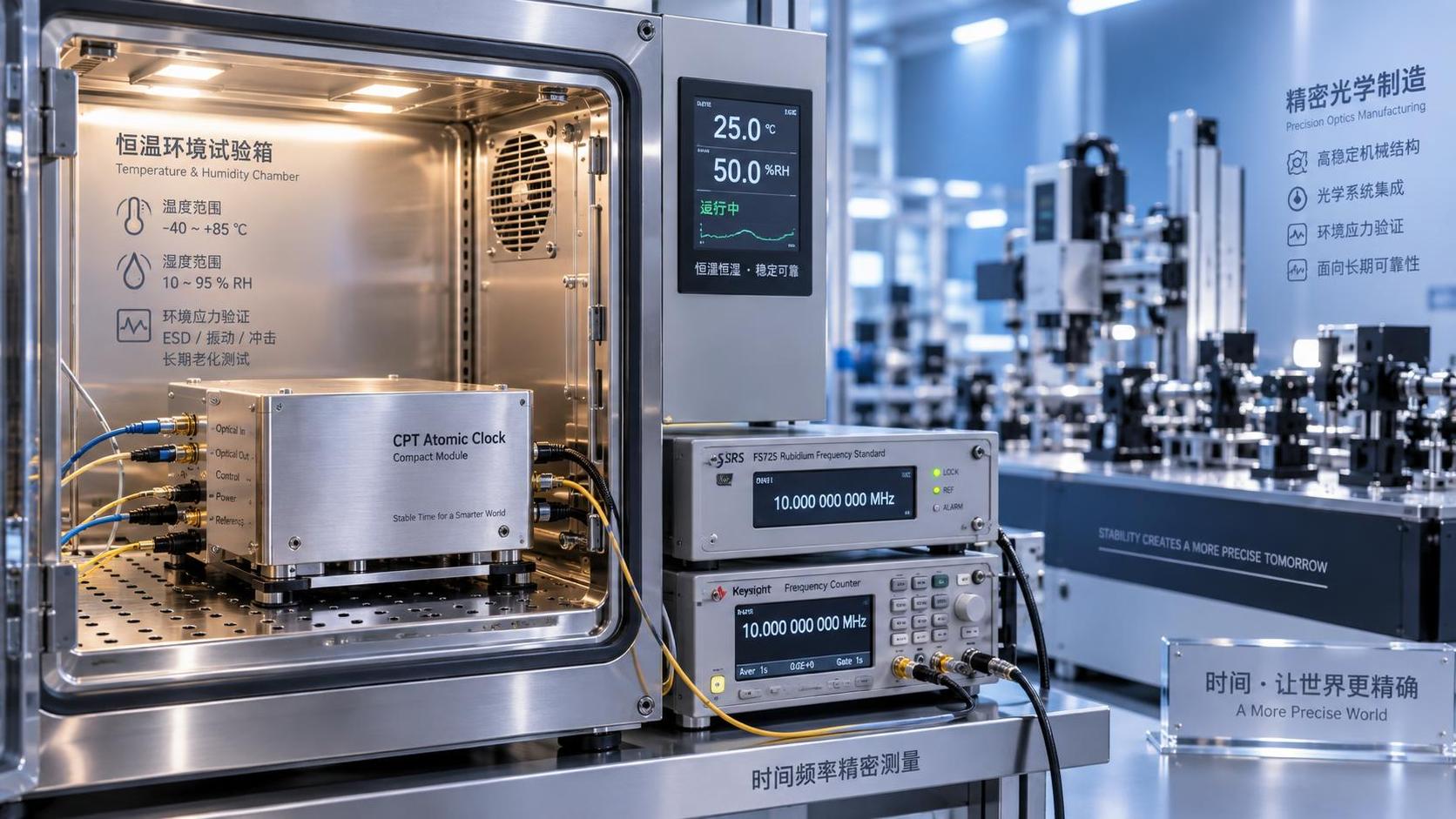
Environmental qualification verifies whether specified CPT atomic clock performance is maintained when surrounding conditions differ from a controlled laboratory environment or change unexpectedly during operation.
Temperature testing should cover the declared operating range, including cold start, hot start, thermal cycling, and stabilization periods at each temperature extreme.
Measure frequency behavior while temperature changes, not only after equilibrium. Rapid transitions can reveal control-loop limitations that remain hidden during static chamber measurements.
Humidity testing is relevant when condensation, storage exposure, or enclosure leakage is credible. The test plan should reflect actual protection levels and installation environments.
Vibration and mechanical shock testing are important for mobile equipment, industrial machinery, transportation systems, and installations near pumps, motors, compressors, or high-speed manufacturing tools.
During vibration testing, monitor output continuity and lock condition whenever practical. Post-test measurements alone may miss intermittent faults that can disrupt a connected timing system.
Mechanical inspections should follow vibration and shock exposure. Check connectors, solder joints, mounting hardware, optical components, shielding, and enclosure integrity before returning units to service.
Environmental acceptance must consider recovery time after stress. A unit that survives exposure but needs an uncontrolled or prolonged recovery period may still fail operational requirements.
Power, EMC, and Interface Resilience Are Safety Requirements
Power-quality testing determines whether the clock maintains safe and specified operation during supply variation, ripple, transients, brownouts, interruption, reverse polarity, and restart conditions.
Test voltage limits should reflect the actual power architecture, including converters, battery backup, cable losses, shared supplies, and expected disturbances from nearby industrial loads.
Document output behavior during every power event. Critical concerns include frequency steps, invalid timing pulses, false lock indications, corrupted data messages, and incomplete system restarts.
Electromagnetic compatibility testing should evaluate both emissions and immunity. A CPT atomic clock may be installed beside lasers, drives, switches, radio modules, and sensitive optical instrumentation.
Immunity evaluation should observe functional performance, not merely whether the device remains powered. Timing outputs, status signals, control interfaces, and recovery behavior all require review.
Interface robustness also deserves attention. Verify reference inputs, serial ports, network timing ports, alarm contacts, and management interfaces across expected cable lengths and grounding conditions.
Cybersecurity-related timing risks should be considered where network synchronization is used. Authentication, source selection, alarm handling, and spoofing resilience can affect trustworthy time distribution.
Safety teams should require explicit behavior for invalid inputs. The device must identify unacceptable reference conditions instead of silently propagating potentially incorrect time or frequency.
Build a Qualification Matrix Instead of Isolated Test Reports
A qualification matrix connects each requirement to a test method, sample size, environmental condition, instrument, acceptance limit, evidence record, and responsible approval owner.
This format helps quality teams identify missing coverage before release. It also simplifies audits because reviewers can trace a requirement directly to objective evidence.
Organize requirements into performance, reliability, environmental, electrical, mechanical, safety, interface, and documentation categories. Avoid allowing one broad test to imply compliance everywhere.
Each result should state pass, fail, conditional pass, or not applicable. Conditional results need documented rationale, operational restrictions, corrective actions, and approval authority.
Define sample selection rules before testing. Random production samples, engineering prototypes, and hand-selected best-performing units provide different confidence levels and should not be treated equally.
When failures occur, preserve raw data and test configuration. Retesting a corrected unit may prove improvement, but it does not erase the original failure mechanism.
Root-cause investigation should determine whether a failure is design-related, process-related, supplier-related, test-related, or caused by an unrealistic but documented operating condition.
Close qualification only when corrective actions have been verified. For high-risk applications, include regression testing to confirm that improvements did not compromise other clock characteristics.
Choosing Acceptance Limits That Support Deployment Decisions
Acceptance limits should be derived from system needs, not copied blindly from component datasheets. The required clock margin depends on architecture, update frequency, and consequence of error.
Translate system timing budgets into device-level limits. Include contributions from distribution networks, cables, interfaces, measurement uncertainty, synchronization algorithms, and downstream equipment sensitivity.
Use guard bands when measurement uncertainty is significant. A unit close to the stated limit may not provide enough confidence for safety-sensitive or tightly controlled manufacturing applications.
Consider both normal operation and credible fault conditions. A clock specification may be acceptable during stable operation but inadequate during reference loss, thermal transients, or supply disturbance.
For each critical limit, define a response action. Examples include blocking release, applying use restrictions, increasing inspection frequency, changing installation controls, or initiating corrective engineering work.
Low power consumption should be evaluated alongside stability. In compact or remote installations, thermal loading and power constraints can influence timing performance and operational reliability.
Supplier qualification should include change-notification requirements. Component substitutions, firmware updates, assembly changes, and calibration changes can alter CPT atomic clock behavior after initial approval.
Periodic requalification is appropriate when the application is critical, the design changes, field conditions evolve, or production data indicates drift from the original qualified baseline.
Conclusion: Qualification Evidence Creates Trustworthy Timing
A reliable CPT atomic clock qualification program evaluates stability, aging, environmental stress, power resilience, interfaces, and failure indication as connected aspects of operational performance.
For quality-control teams, the goal is repeatable evidence that units meet measurable requirements. For safety teams, the goal is predictable behavior when conditions become abnormal.
The strongest programs begin with system risk, convert that risk into acceptance limits, and use traceable testing to validate both performance and recovery behavior.
When qualification data is organized into a clear matrix, optical manufacturing equipment and critical infrastructure operators can make better release, maintenance, and deployment decisions with confidence.
Ultimately, a CPT atomic clock should be selected and approved not only for impressive laboratory specifications, but for verified stability and safe behavior throughout its real operating lifecycle.
