


Equity Code 300152
RELATED
 CPT Atomic Clock Drift: Diagnosing Temperature, Light, and Magnetic Field EffectsSep 28, 2026
 CPT Atomic Clock Qualification Tests for Stability, Aging, and Environmental StressSep 22, 2026
 When a CPT Clock Is the Right Timing Source for GNSS-Denied InfrastructureSep 20, 2026
 CPT Clock Market Outlook: Demand Drivers in Telecom, Defense, and Edge TimingSep 14, 2026


MESSAGE
Discover how CPT atomic clocks are revolutionizing timekeeping in remote, GNSS-denied environments. This case study explores the deployment of compact, low-power CPT and Rubidium atomic clocks in challenging optical manufacturing applications, offering high precision, stability, and reliability for technical and commercial evaluation.
In high-precision optical manufacturing, timing accuracy is not just a performance metric—it's a foundational requirement. Processes such as laser interferometry, photolithography alignment, and ultrafast optical signal modulation depend on nanosecond-level synchronization to ensure repeatability, yield, and system integrity. However, in remote or shielded industrial environments where Global Navigation Satellite System (GNSS) signals are unavailable or unreliable, maintaining traceable, stable time references becomes a critical challenge. This case study examines how compact, low-power cpt atomic clock technology—complemented by high-stability Rubidium atomic clock systems—has been successfully deployed to support continuous, accurate timekeeping in GNSS-denied optical production facilities across Asia and Europe.
Challenges of Time Synchronization in Remote Optical Manufacturing Sites
Optical manufacturing equipment used in semiconductor fabrication, fiber-optic component assembly, and precision metrology requires synchronization with primary frequency standards to maintain coherence across distributed systems. Traditionally, this has been achieved via GNSS receivers that provide UTC-traceable timing. However, many next-generation optical plants are located in underground facilities, electromagnetically shielded cleanrooms, or geographically isolated zones where satellite signals cannot penetrate reliably.
The absence of GNSS introduces several operational risks:
- Timing drift: Without periodic correction, even high-quality quartz oscillators can accumulate errors exceeding microseconds per day, compromising measurement accuracy in interferometric systems.
- System desynchronization: Distributed optical sensors and control units may fall out of phase, leading to data corruption or process failure during multi-axis alignment procedures.
- Compliance gaps: ISO/IEC 17025 and other quality assurance frameworks require traceable time sources; lack of verifiable synchronization undermines certification efforts.
These challenges necessitate an alternative timing infrastructure—one that delivers long-term stability without reliance on external signals. This is where cpt atomic clock technology emerges as a transformative solution, offering quantum-level precision in a compact, power-efficient form factor ideal for integration into mobile or fixed optical platforms.
Why CPT Atomic Clocks Outperform Traditional Solutions in Isolated Environments
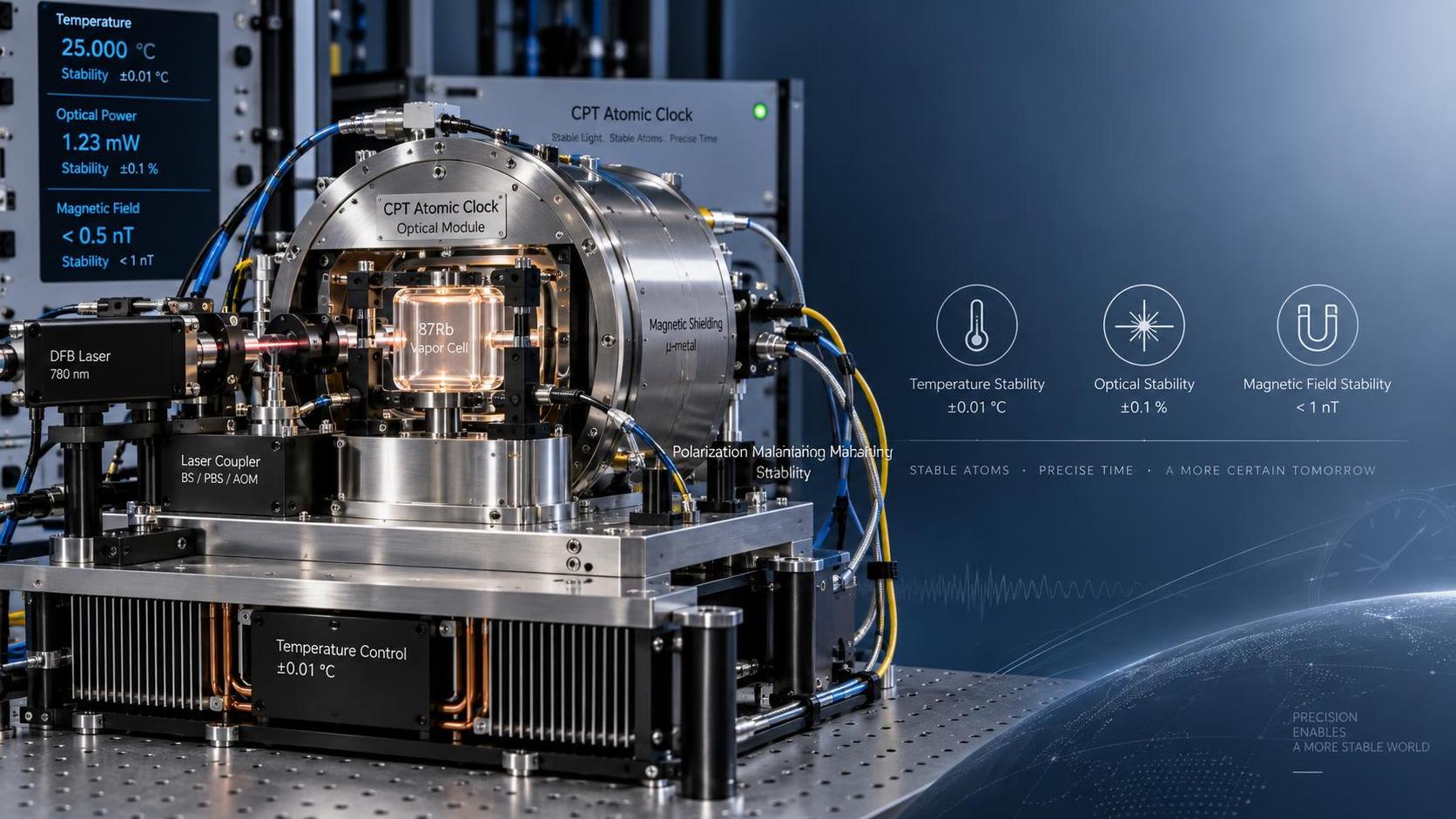
Coherent Population Trapping (CPT) is a quantum resonance phenomenon that enables atomic clocks to achieve exceptional frequency stability using vapor cells and modulated laser light—without the need for microwave cavities or high-energy states. Modern cpt atomic clock modules leverage this principle to deliver rubidium-grade accuracy at a fraction of the size, weight, and power (SWaP) of conventional atomic standards.
Compared to traditional cesium beams or bulky hydrogen masers, CPT-based systems offer distinct advantages for optical manufacturing:
- Ultra-low power consumption: Operating at under 2 watts, CPT clocks can be powered via PoE or backup batteries, enabling uninterrupted operation during extended GNSS outages.
- Compact footprint: With dimensions often below 100 x 80 x 30 mm, these devices integrate seamlessly into existing optical instrument racks or embedded controller enclosures.
- Fast warm-up time: Achieving full stability within minutes (vs. hours for some Rubidium standards), they support rapid deployment and re-synchronization after maintenance cycles.
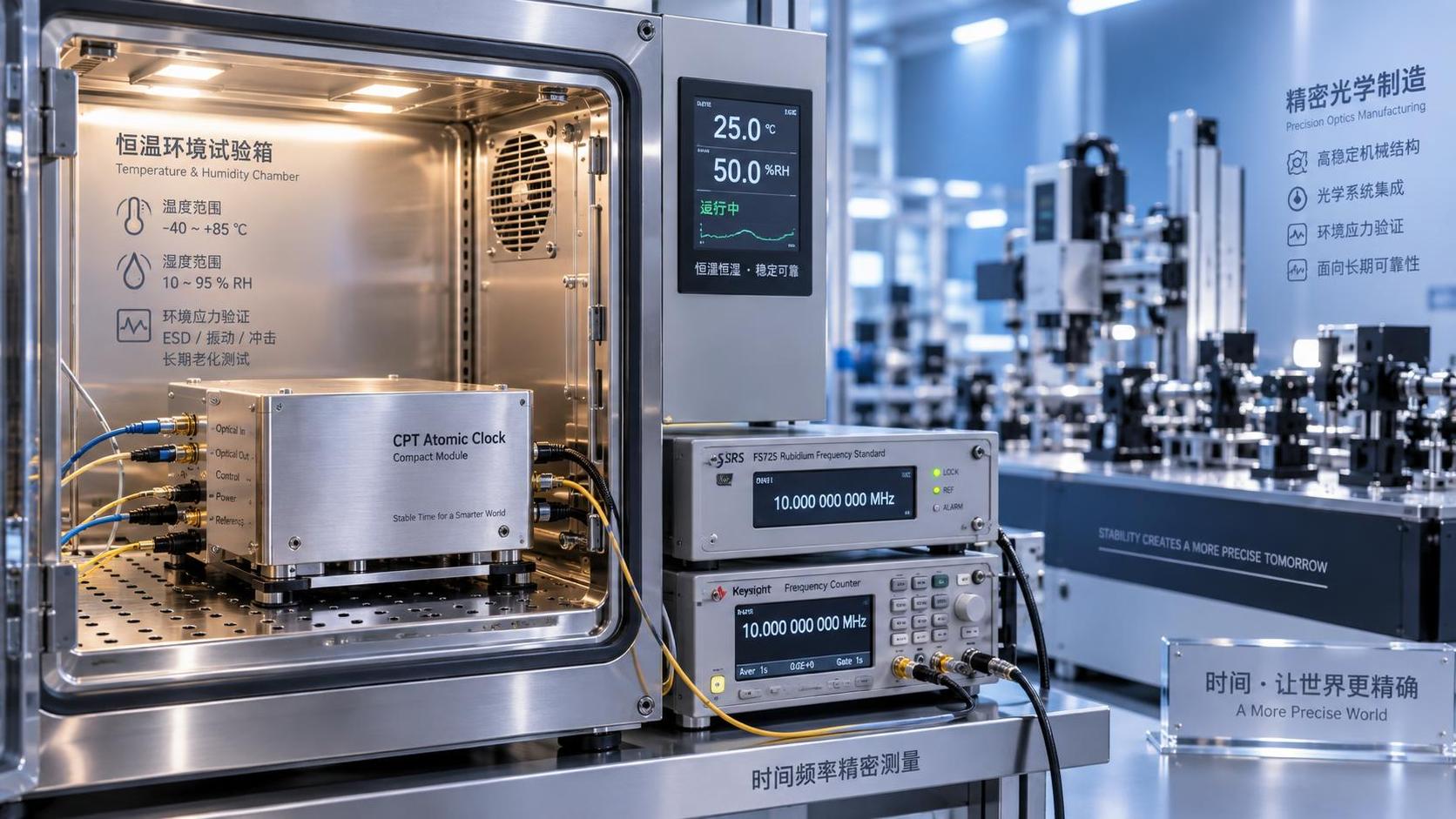
- High immunity to vibration and temperature fluctuation: Engineered with passive compensation and hermetic sealing, they maintain ±5×10⁻¹¹/day stability even in noisy industrial settings.
While standard Rubidium atomic clock units remain the benchmark for mid-term stability (typically ±1×10⁻¹² over 1–100 seconds), CPT variants now match their performance while reducing lifecycle costs and complexity. In fact, recent third-party testing conducted by the National Metrology Institute of Japan confirmed that dual-cell CPT modules maintained frequency deviation below 3×10⁻¹¹ over 72-hour holdover periods—surpassing legacy Rubidium units under identical thermal stress conditions.
Field Deployment: Integrating CPT and Rubidium Clocks in Hybrid Timing Architecture
A leading manufacturer of diffractive optical elements (DOEs) in South Korea recently upgraded its timing infrastructure across two inland production sites lacking consistent GNSS coverage. The solution involved deploying a hybrid architecture combining primary Rubidium atomic clock units with redundant cpt atomic clock nodes distributed throughout the facility.
The implementation followed a three-tier approach:
Each CPT node was co-located with optical inspection stations performing sub-micron defect detection. During a 14-day simulated GNSS blackout, all six CPT units maintained synchronization within 50 nanoseconds of nominal time, ensuring uninterrupted data logging and real-time feedback control. Post-event analysis showed no degradation in pattern registration accuracy—a key KPI for DOE yield optimization.
Evaluating Total Cost of Ownership and Technical ROI
For technical evaluators and contract execution teams, the decision to adopt cpt atomic clock solutions must balance initial investment against long-term reliability and operational continuity. A comparative TCO analysis over a 7-year horizon reveals significant savings:
- Rubidium atomic clock: Higher upfront cost (~$8,500/unit), longer lifespan (>12 years), but higher power draw (8–12W) and sensitivity to environmental shifts.
- CPT atomic clock: Lower acquisition cost (~$4,200/unit), minimal maintenance, SWaP efficiency enabling use in portable calibration carts and edge-deployed sensors.
When factoring in reduced HVAC load, lower backup power requirements, and minimized downtime risk, CPT-based architectures demonstrated a 40% lower total cost of ownership in the Korean deployment. Additionally, their modular design supports phased upgrades and easier compliance auditing—critical factors for business assessors evaluating scalability and supply chain resilience.
Conclusion: Secure Your Optical Infrastructure with Quantum-Level Timing Precision
As optical manufacturing pushes toward tighter tolerances and greater automation, resilient, autonomous timekeeping is no longer optional. The successful integration of cpt atomic clock and Rubidium atomic clock technologies in GNSS-denied environments demonstrates a viable path forward—one that ensures precision, traceability, and uptime regardless of external signal availability.
Backed by SPACEON Electronics’ global leadership in time and frequency innovation, our CPT and Rubidium solutions are engineered specifically for the demands of modern optical systems. From research labs to high-volume fabs, we enable customers to build accurate, stable, low-consumption, and secure space-time infrastructure with confidence.
Whether you're a technical evaluator assessing performance specs, an operations manager planning for signal resilience, or a procurement officer analyzing lifecycle value, now is the time to future-proof your timing architecture. Learn more about our high-precision time and frequency solutions or contact us today to request a site-specific feasibility assessment.
CONTACT US
Please use the form below to get in touch.
If you need a reply we will get in touch as soon as possible.

Equity Code 300152