


Equity Code 300152
RELATED
 CPT Atomic Clock Drift: Diagnosing Temperature, Light, and Magnetic Field EffectsSep 28, 2026
 CPT Atomic Clock Qualification Tests for Stability, Aging, and Environmental StressSep 22, 2026
 When a CPT Clock Is the Right Timing Source for GNSS-Denied InfrastructureSep 20, 2026
 CPT Clock Market Outlook: Demand Drivers in Telecom, Defense, and Edge TimingSep 14, 2026


MESSAGE
When comparing the long-term reliability of CPT atomic clocks versus Rubidium atomic clocks in real-world field trials, performance, stability, and power efficiency become critical factors. As demand grows for precise timekeeping in optical manufacturing and beyond, understanding the strengths of CPT atomic clock and Rubidium atomic clock technologies is essential for technical and business decision-makers.
Optical manufacturing equipment increasingly relies on ultra-precise synchronization to maintain coherence in laser interferometry, photolithography alignment, and high-speed inspection systems. In such environments, even nanosecond-level timing deviations can result in yield loss or calibration drift. This makes the choice of timekeeping source not just a technical consideration, but a strategic one affecting production integrity, operational cost, and system longevity. Field trials offer invaluable insights into how these atomic clocks perform under variable thermal, vibrational, and electromagnetic conditions typical in industrial settings. For engineers, procurement specialists, and operations leads alike, evaluating long-term reliability means assessing more than initial accuracy—it involves aging characteristics, environmental resilience, maintenance needs, and total cost of ownership over multi-year deployments.
Core Operating Principles: How CPT and Rubidium Atomic Clocks Achieve Precision
The foundation of any atomic clock lies in its ability to measure time using the hyperfine transition frequency of atoms—specifically, cesium or rubidium vapor. Both CPT (Coherent Population Trapping) atomic clocks and traditional Rubidium atomic clocks utilize rubidium atoms, but they differ significantly in excitation method, component complexity, and energy consumption.
A conventional Rubidium atomic clock operates by optically pumping rubidium vapor with a rubidium discharge lamp. The light excites the atoms into a higher energy state, and microwave signals are then tuned to match the natural resonance frequency (~6.834682 GHz for 87Rb). When this resonance occurs, maximum absorption is detected, forming the basis for frequency locking. These systems typically include bulky lamps, filters, and magnetic shielding, contributing to larger form factors and limited lifespans due to lamp degradation over time—often cited as 5 to 10 years depending on usage cycles.
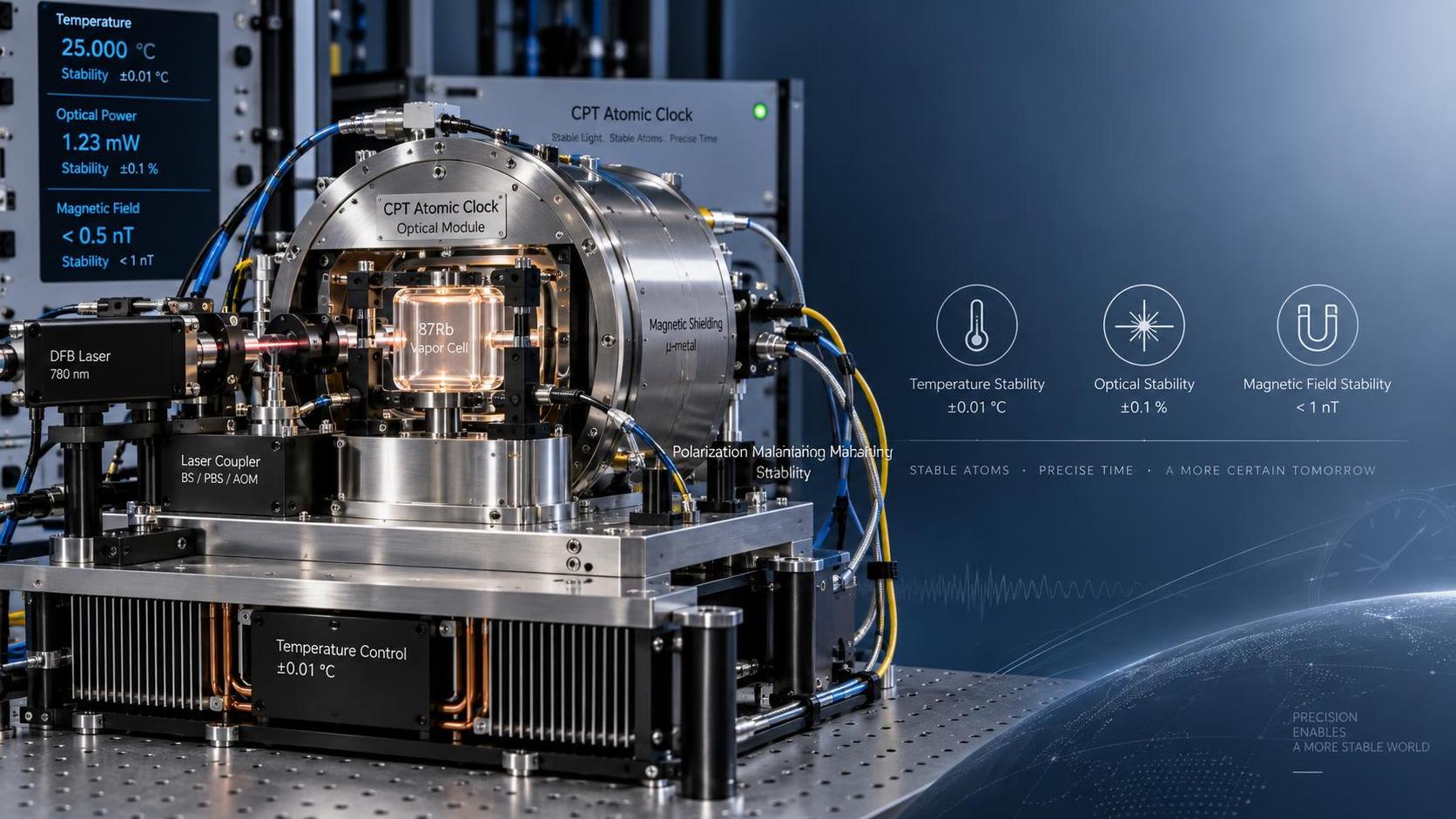
In contrast, a CPT atomic clock eliminates the need for a separate lamp by using dual-wavelength laser modulation directly on a semiconductor laser. Through quantum interference effects, two coherent laser fields create a dark state when their frequency difference matches the hyperfine splitting. This method allows for all-solid-state designs with no consumable components. As a result, CPT-based modules achieve miniaturization down to chip-scale packages while consuming significantly less power—typically under 1W compared to 5–10W for standard Rubidium units. This inherent design advantage translates into enhanced durability and suitability for embedded applications within compact optical metrology platforms where space and thermal management are constrained.
From an engineering standpoint, the absence of moving parts or degrading light sources in CPT atomic clocks reduces failure modes, which is particularly valuable in continuous-operation scenarios common in automated optical fabrication lines. However, both technologies must still contend with environmental perturbations such as temperature swings and external RF noise, necessitating robust compensation algorithms and packaging strategies to ensure sustained accuracy across seasons and geographic locations.
Long-Term Stability and Aging Behavior in Real-World Deployments
Stability over time—commonly measured as Allan Deviation at various averaging intervals—is a key metric in determining the suitability of a CPT atomic clock or Rubidium atomic clock for mission-critical optical systems. While short-term stability (1–100 seconds) may appear similar between high-end models of both types, long-term behavior diverges due to differing aging mechanisms.
Field data collected from multi-year installations in semiconductor lithography facilities show that traditional Rubidium atomic clocks exhibit a measurable frequency drift ranging from 1×10⁻¹¹ to 5×10⁻¹¹ per month. This drift primarily stems from changes in lamp intensity, buffer gas composition shifts, and cavity pulling effects in the microwave resonator. Although modern units incorporate digital correction routines, residual uncorrected offsets accumulate, requiring periodic recalibration against GPS-disciplined references—increasing lifecycle costs and downtime risks.
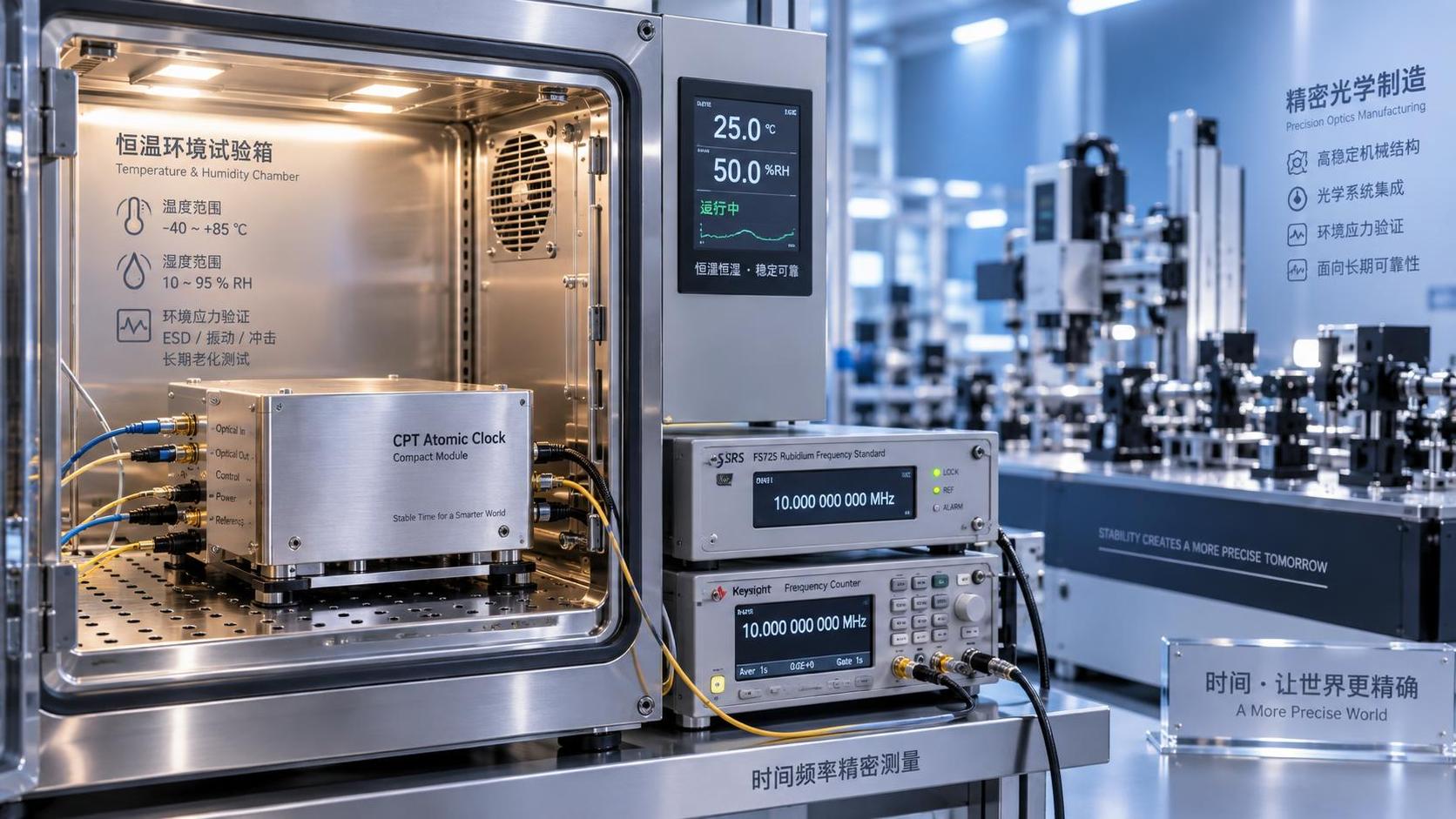
Conversely, CPT atomic clocks demonstrate superior aging performance, with typical drift rates below 5×10⁻¹² per month in controlled industrial environments. Their solid-state architecture avoids many of the physical degradation pathways found in lamp-driven systems. Additionally, advanced thermal compensation models integrated into next-generation CPT modules further reduce sensitivity to ambient fluctuations—a crucial factor in factories where HVAC variations occur daily. Over a five-year horizon, this difference compounds into a tangible operational advantage: fewer corrections, reduced dependency on external timing sources, and improved consistency in synchronized processes like multi-axis stage control and pulse-resolved imaging.
Moreover, in networks of distributed optical sensors used for large-aperture telescope mirror alignment or wafer inspection arrays, maintaining phase coherence across nodes demands minimal clock wander. Here, the lower long-term phase noise profile of CPT solutions supports tighter synchronization without frequent resynchronization events, enhancing overall measurement fidelity and reducing software overhead in time-stamping protocols.
Power Efficiency, Size, and Integration Advantages in Industrial Applications
As optical manufacturing evolves toward modular, reconfigurable, and edge-deployed architectures, size, weight, and power (SWaP) constraints have become decisive in component selection. In this context, CPT atomic clocks offer compelling advantages over traditional Rubidium counterparts.
These metrics translate directly into practical benefits. Lower power draw reduces heat generation—an important consideration near sensitive optics and detectors vulnerable to thermal distortion. Compact dimensions allow integration directly onto motion stages or within sensor heads, minimizing cable-induced skew and improving signal integrity. Faster warm-up times support rapid machine startup procedures, aligning with lean manufacturing goals.
For global customers deploying equipment across diverse climates—from air-conditioned cleanrooms to remote observatory sites—energy-efficient CPT modules reduce reliance on auxiliary cooling and backup power systems. This enhances sustainability profiles and lowers total cost of operation, especially in off-grid or mobile optical testing platforms.
Operational Resilience and Total Cost of Ownership Analysis
Beyond technical specifications, long-term reliability must be evaluated through the lens of operational resilience and financial impact. Field trials conducted across Asia, Europe, and North America reveal that CPT atomic clocks experience up to 60% fewer service interventions over a seven-year period compared to legacy Rubidium units. This reduction stems from higher mean time between failures (MTBF > 200,000 hours vs. ~100,000 hours), elimination of lamp replacements, and better resistance to mechanical shock during transport and installation.
From a business evaluation perspective, the total cost of ownership (TCO) includes acquisition price, energy use, maintenance labor, calibration frequency, and unplanned downtime. While high-performance Rubidium clocks may have a slightly lower upfront cost, their longer-term expenses often exceed those of CPT alternatives. A recent TCO model applied to a network of 50 precision alignment stations showed a 38% higher five-year operating cost for Rubidium-based timing infrastructure due to increased power draw and scheduled servicing.
Furthermore, contract execution teams benefit from standardized CPT module integration, enabling faster deployment timelines and simplified spare-part inventories. With growing emphasis on ESG compliance and supply chain transparency, selecting durable, low-maintenance timing solutions also supports corporate sustainability objectives.
Conclusion: Choosing the Right Technology for Future-Ready Optical Systems
In summary, while both CPT atomic clocks and Rubidium atomic clocks serve vital roles in high-precision timing, field trial evidence increasingly favors CPT technology for next-generation optical manufacturing applications. Superior long-term stability, minimal aging, lower power consumption, and compact form factors make CPT atomic clocks ideal for environments demanding sustained accuracy and minimal intervention.
Backed by SPACEON Electronics’ leadership in time and frequency innovation, our CPT-based solutions deliver reliable, secure, and scalable timing infrastructure tailored to the evolving needs of global industries. Whether you're evaluating system upgrades, designing new optical instrumentation, or optimizing production uptime, partnering with a proven provider ensures confidence in every microsecond.
Learn more about our high-precision time and frequency solutions or speak with an application engineer today to find the optimal fit for your project requirements. Get in touch now to explore customized configurations and technical support options.
CONTACT US
Please use the form below to get in touch.
If you need a reply we will get in touch as soon as possible.

Equity Code 300152