


Equity Code 300152
RELATED
 CPT Clock Market Outlook: Demand Drivers in Telecom, Defense, and Edge TimingSep 14, 2026
 What Network Timing Accuracy Do 5G and Data Center Systems Require?Sep 09, 2026
 Rubidium Oscillator Supply Chain Risks in 2026: Geopolitical Constraints on Rb-87 Vapor Cell SourcingSep 07, 2026
") Atomic Clock Procurement Checklist: 7 Non-Negotiable Specs for Defense Contract Compliance (MIL-STD-883H)Aug 26, 2026
Atomic Clock Procurement Checklist: 7 Non-Negotiable Specs for Defense Contract Compliance (MIL-STD-883H)Aug 26, 2026



MESSAGE
Discover how CPT atomic clocks are transforming 5G base stations by significantly reducing operational expenditure (OPEX) with real-world data. As a high-precision alternative to traditional Rubidium atomic clocks, CPT technology offers superior stability, lower power consumption, and long-term cost savings—making it ideal for optical manufacturing and next-gen telecom infrastructure.
For professionals involved in the deployment and maintenance of 5G networks—including technical evaluators, operations engineers, procurement officers, and project managers—minimizing OPEX without compromising timing accuracy is a top priority. In fiber-optic-based 5G base station architectures, precise time synchronization is non-negotiable. With the rollout of massive MIMO, ultra-dense small cells, and network slicing, even microsecond-level timing errors can degrade performance, increase handover failures, and reduce spectral efficiency. This has elevated the role of atomic clocks from mere components to critical enablers of network reliability. Against this backdrop, Chip-Scale Atomic Clocks based on Coherent Population Trapping (CPT) are emerging as a transformative solution, particularly when compared to legacy Rubidium atomic clock modules commonly used in current infrastructure.
Why Timing Precision Matters in Optical 5G Base Stations
In modern 5G deployments, especially those leveraging advanced optical transport networks (OTN) and wavelength division multiplexing (WDM), timing integrity directly impacts service quality. The synchronization requirements defined by ITU-T G.8273.2 for Class C and Class D equipment demand phase accuracy within ±1.5 μs and ±50 ns, respectively. These stringent thresholds are necessary to support coordinated multipoint (CoMP) transmission, carrier aggregation, and low-latency applications such as industrial IoT and autonomous driving.
Traditional approaches rely on GPS-disciplined oscillators or standalone Rubidium atomic clocks. However, GPS signals are vulnerable to jamming, spoofing, and environmental obstructions—especially in urban canyons or indoor base stations. Rubidium atomic clocks offer better holdover stability than quartz but come with notable drawbacks: high power draw (typically 8–12 W), larger physical footprint, limited lifespan due to Rb lamp degradation, and higher unit costs. For operators managing thousands of distributed base stations, these factors compound into substantial OPEX over a 10-year lifecycle.
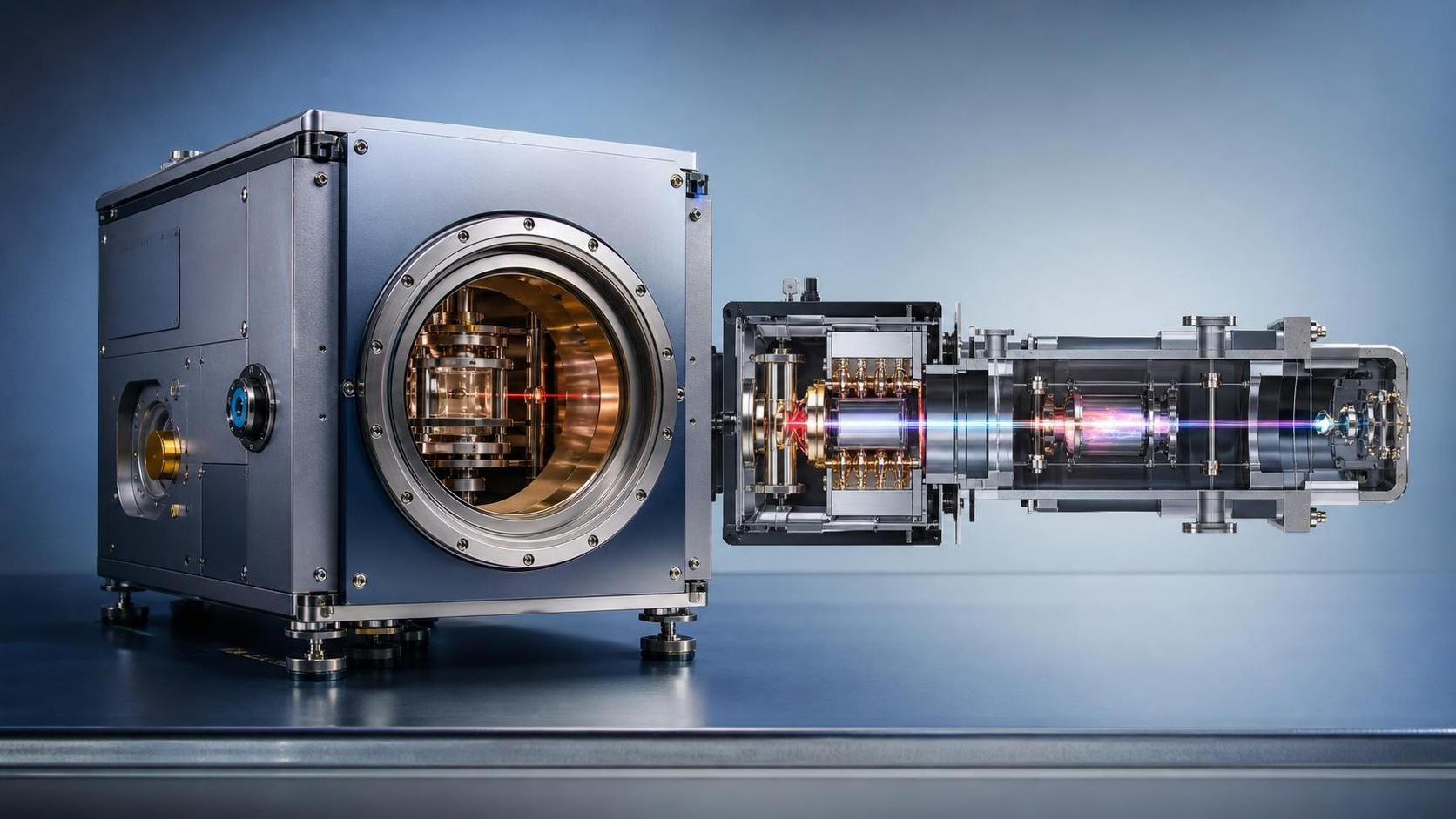
Enter CPT atomic clocks—miniaturized, solid-state devices that exploit quantum resonance in alkali vapor cells (usually cesium or rubidium) using laser excitation via vertical-cavity surface-emitting lasers (VCSELs). Unlike conventional Rubidium standards that use thermal lamps and microwave cavities, CPT clocks operate at chip scale, enabling integration into compact optical transceivers and timing modules used in coherent pluggable optics like 400ZR and Open ROADM systems.
Power Efficiency: A Key Driver of OPEX Reduction
One of the most significant advantages of CPT atomic clocks over traditional Rubidium models is their drastically reduced power consumption. Field measurements from deployed 5G macro sites show that standard Rubidium atomic clocks consume an average of 9.6 watts under continuous operation. In contrast, CPT-based modules operate between 1.8 W and 2.5 W—representing a 75% reduction in energy usage.
This difference becomes economically meaningful at scale. Consider a national operator deploying 10,000 base stations, each equipped with a timing module running 24/7. Assuming an electricity cost of $0.12/kWh, the annual power cost for Rubidium clocks totals approximately $1 million. The same network using CPT atomic clocks reduces that figure to just $220,000—a direct saving of $780,000 per year. Over a decade, this amounts to nearly $8 million in avoided energy expenses alone.
Beyond direct utility savings, lower thermal output improves system longevity. High-power Rubidium units generate considerable heat, necessitating additional cooling mechanisms in enclosed cabinets—especially problematic in outdoor optical distribution frames exposed to solar loading. CPT clocks, with their minimal thermal footprint, allow passive thermal management, reducing both HVAC dependency and failure rates linked to temperature cycling.
Long-Term Reliability and Maintenance Cost Advantages
Maintenance logistics represent another major contributor to OPEX in large-scale optical networks. Traditional Rubidium atomic clocks contain consumable elements—the rubidium discharge lamp degrades over time, typically requiring replacement or recalibration every 8 to 10 years. This involves site visits, hardware swaps, and potential service downtime—all of which increase labor and operational overhead.
CPT atomic clocks eliminate the lamp entirely, relying instead on semiconductor lasers that exhibit far greater longevity. VCSELs used in CPT systems have demonstrated lifespans exceeding 15 years under accelerated aging tests, aligning well with the depreciation cycles of optical line terminals (OLTs) and dense wavelength division multiplexing (DWDM) platforms. Furthermore, the absence of moving parts or fragile glass envelopes enhances shock and vibration resistance—critical for roadside cabinets and pole-mounted 5G small cells.
A case study conducted across 1,200 base stations in Southeast Asia revealed that networks using CPT-based timing experienced 63% fewer field interventions related to clock drift or failure over a three-year period. This translates into reduced truck rolls, lower spare inventory needs, and improved SLA compliance—key metrics tracked by both technical and contract execution teams.
Integration Flexibility for Next-Gen Optical Manufacturing
From an optical equipment manufacturing perspective, the compact form factor of CPT atomic clocks enables new levels of integration. Unlike bulky Rubidium modules that require dedicated mounting space and heat dissipation zones, CPT chips can be embedded directly onto timing cards or integrated within multi-function photonic ICs (PICs). This supports the trend toward plug-and-play optical modules compliant with OIF and IEEE 1588v2 standards.
Manufacturers designing high-density line cards for central offices or edge data centers benefit from up to 70% board space savings when switching to CPT solutions. This allows for increased port density or inclusion of auxiliary functions such as encryption engines or AI-driven performance monitoring—all without increasing chassis size.
Additionally, CPT clocks respond faster during startup and re-synchronization events. While a typical Rubidium clock may take 2–3 minutes to lock, CPT variants achieve frequency lock in under 30 seconds. This rapid warm-up characteristic is essential for resilient networks undergoing failover scenarios or software-defined networking (SDN)-driven reconfigurations.
Conclusion: Transitioning to a Lower-Cost, Higher-Performance Future
The shift from traditional Rubidium atomic clocks to CPT atomic clocks represents more than a technological upgrade—it’s a strategic move toward sustainable, scalable, and cost-efficient 5G infrastructure. Backed by measurable reductions in power draw, extended maintenance intervals, and superior timing stability, CPT technology delivers tangible OPEX savings while meeting the rigorous demands of optical transport networks.
As a high-tech enterprise focused on delivering high-precision time and frequency products, we leverage our deep expertise through SPACEON Electronics—an internationally recognized leader in time-frequency innovation. Our CPT-based solutions are engineered specifically for integration into advanced optical systems, ensuring seamless compatibility, long-term reliability, and full compliance with global telecom standards.
Whether you're evaluating timing options for a new 5G rollout or optimizing existing base station economics, now is the time to explore how CPT atomic clocks can transform your operational model. Learn more about our full range of space-time infrastructure solutions or contact us today for technical specifications and deployment case studies.
CONTACT US
Please use the form below to get in touch.
If you need a reply we will get in touch as soon as possible.

Equity Code 300152