


Equity Code 300152
RELATED
 CPT Atomic Clock Drift: Diagnosing Temperature, Light, and Magnetic Field EffectsSep 28, 2026
 CPT Atomic Clock Qualification Tests for Stability, Aging, and Environmental StressSep 22, 2026
 When a CPT Clock Is the Right Timing Source for GNSS-Denied InfrastructureSep 20, 2026
 CPT Clock Market Outlook: Demand Drivers in Telecom, Defense, and Edge TimingSep 14, 2026
MESSAGE
For technical evaluators assessing next-generation timing systems, Satellite Atomic stands out by enhancing timing stability through ultra-precise frequency control, low-drift performance, and reliable operation in demanding environments. Backed by advanced time and frequency expertise, it helps build accurate, stable, and secure synchronization infrastructure for applications where long-term consistency and system resilience are critical.
In optical manufacturing equipment, timing is not a background utility. It directly affects motion coordination, laser pulse consistency, sensor alignment, interferometric measurement accuracy, and the repeatability of automated production steps.
When evaluators compare timing architectures for wafer inspection tools, precision metrology platforms, laser processing stations, or optical coating systems, the practical question is simple: how does Satellite Atomic improve timing stability under real operating loads, temperature shifts, and long service cycles?
The answer lies in frequency stability, low drift behavior, holdover capability, synchronization resilience, and system-level integration. For buyers building accurate, low-consumption, and secure space-time infrastructure, those factors determine whether a timing source remains dependable after 24 hours, 30 days, or several maintenance intervals.
Why timing stability matters in optical manufacturing equipment
Optical manufacturing equipment often runs across multi-axis motion systems, high-speed data acquisition modules, laser drivers, industrial networks, and precision control loops. If timing jitter or frequency drift rises beyond acceptable thresholds, the machine may still run, but process accuracy starts to degrade.
In many optical production lines, synchronization errors are measured in nanoseconds to microseconds, while mechanical positioning errors may be controlled within sub-micron ranges. That means the clock source must support both short-term stability and long-term consistency.
Typical impact points inside precision optical systems
- Laser pulse triggering for cutting, marking, or micro-structuring
- Camera and sensor exposure alignment in machine vision inspection
- Interferometer and encoder synchronization in precision metrology
- Distributed controller coordination across 3 to 12 subsystems
- Network time consistency for data logging, diagnostics, and traceability
If timing instability appears in only one of these nodes, the error can propagate. A 1 microsecond offset may be negligible for general automation, yet it can become meaningful in ultrafast optical inspection, phase-sensitive measurement, or synchronized laser scanning processes.
Common evaluator concerns
Technical evaluators usually focus on four measurable questions: how stable the source is over time, how it behaves during signal loss, how quickly it locks after startup, and how well it performs across varying temperature bands such as 0°C to 50°C or wider industrial ranges.
Satellite Atomic is relevant here because atomic-based timing references are designed to reduce dependence on external timing quality once locked, while maintaining predictable behavior during disturbance, vibration exposure, and long operating cycles.
The table below shows how timing stability influences key operating functions in optical manufacturing environments.
For evaluators, the key takeaway is that timing stability is not an isolated clock metric. It affects throughput consistency, calibration intervals, scrap control, and process repeatability across the entire optical manufacturing chain.
How Satellite Atomic improves timing stability at system level
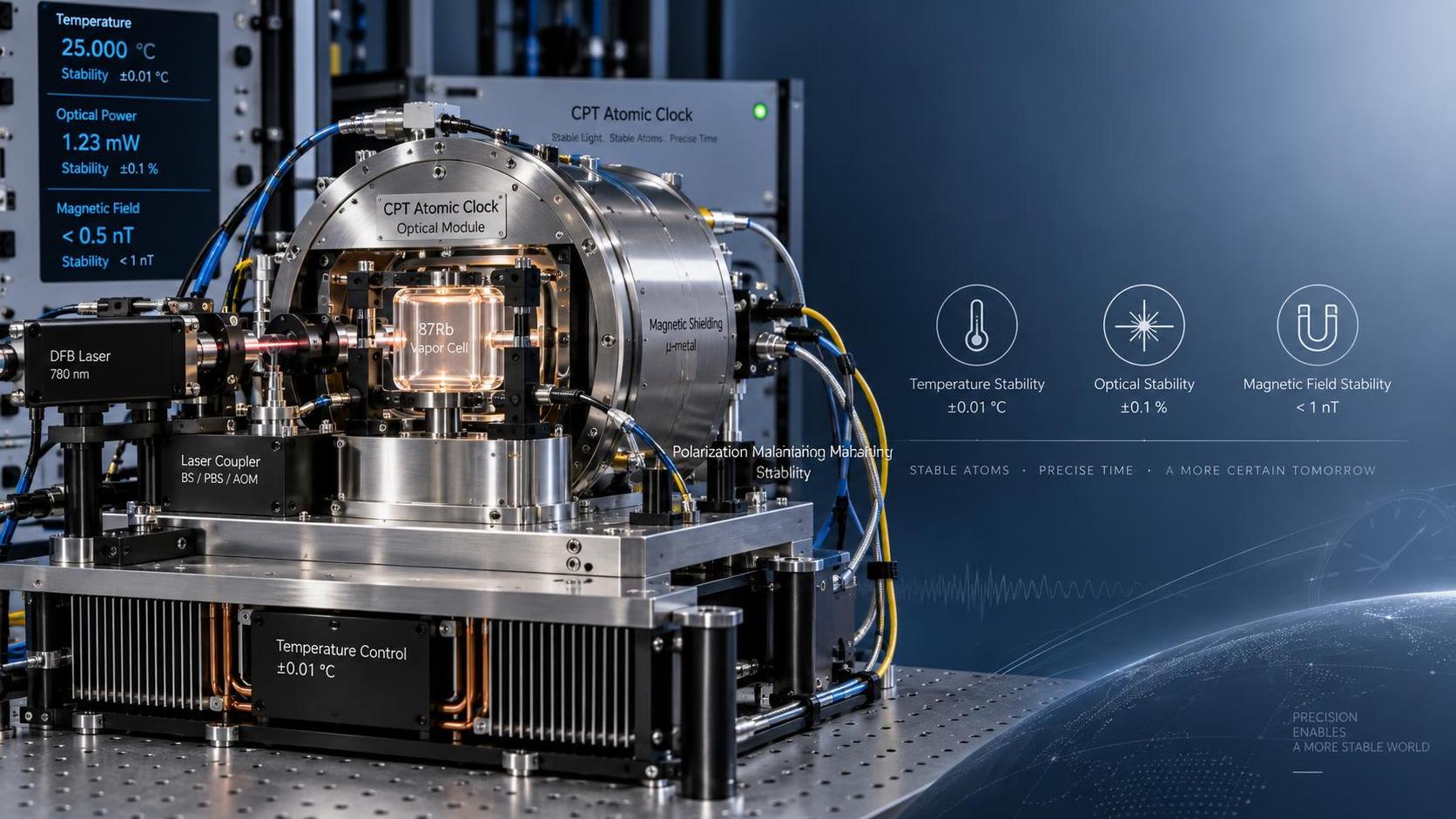
Satellite Atomic improves timing stability by combining an ultra-stable atomic reference with disciplined synchronization behavior, low drift holdover, and reliable output continuity. In optical manufacturing, that combination is more valuable than a nominal accuracy figure alone.
1. Ultra-precise frequency control reduces cumulative timing error
At the core of Satellite Atomic is a frequency reference designed to remain highly stable over extended periods. This matters because optical equipment often runs in shifts of 8 to 24 hours, and small frequency deviations can accumulate into meaningful synchronization offsets.
In practical terms, better frequency control means fewer trigger deviations, steadier sampling intervals, and more consistent coordination between motion, imaging, and laser modules. For equipment with tightly linked control loops, this reduces timing-induced process variation.
What evaluators should examine
- Short-term stability during active processing windows
- Long-term drift over 24-hour, 7-day, and 30-day operation
- Output consistency under thermal and electrical fluctuations
- Interaction with downstream timing distribution hardware
2. Low-drift holdover protects production during reference loss
Many optical manufacturing sites depend on GNSS or network timing as an external reference. But production stability cannot depend on perfect reference availability. Interference, maintenance windows, indoor installation limits, or cable faults can interrupt upstream synchronization.
This is where Satellite Atomic delivers a major advantage. During holdover, the local atomic reference helps preserve timing stability far better than standard quartz-based architectures. The result is reduced drift during temporary signal loss, often the difference between continued operation and forced process pause.
3. Low phase noise supports precision optical measurement
For interferometric systems, coherent optical measurements, and high-resolution acquisition chains, phase noise is not a secondary specification. It influences measurement clarity, signal integrity, and the repeatability of fine-resolution scanning tasks.
A stable atomic reference can help lower timing-related uncertainty in these environments. That does not replace proper shielding, thermal management, or system design, but it improves the foundation on which those controls depend.
4. Reliable operation in demanding industrial environments
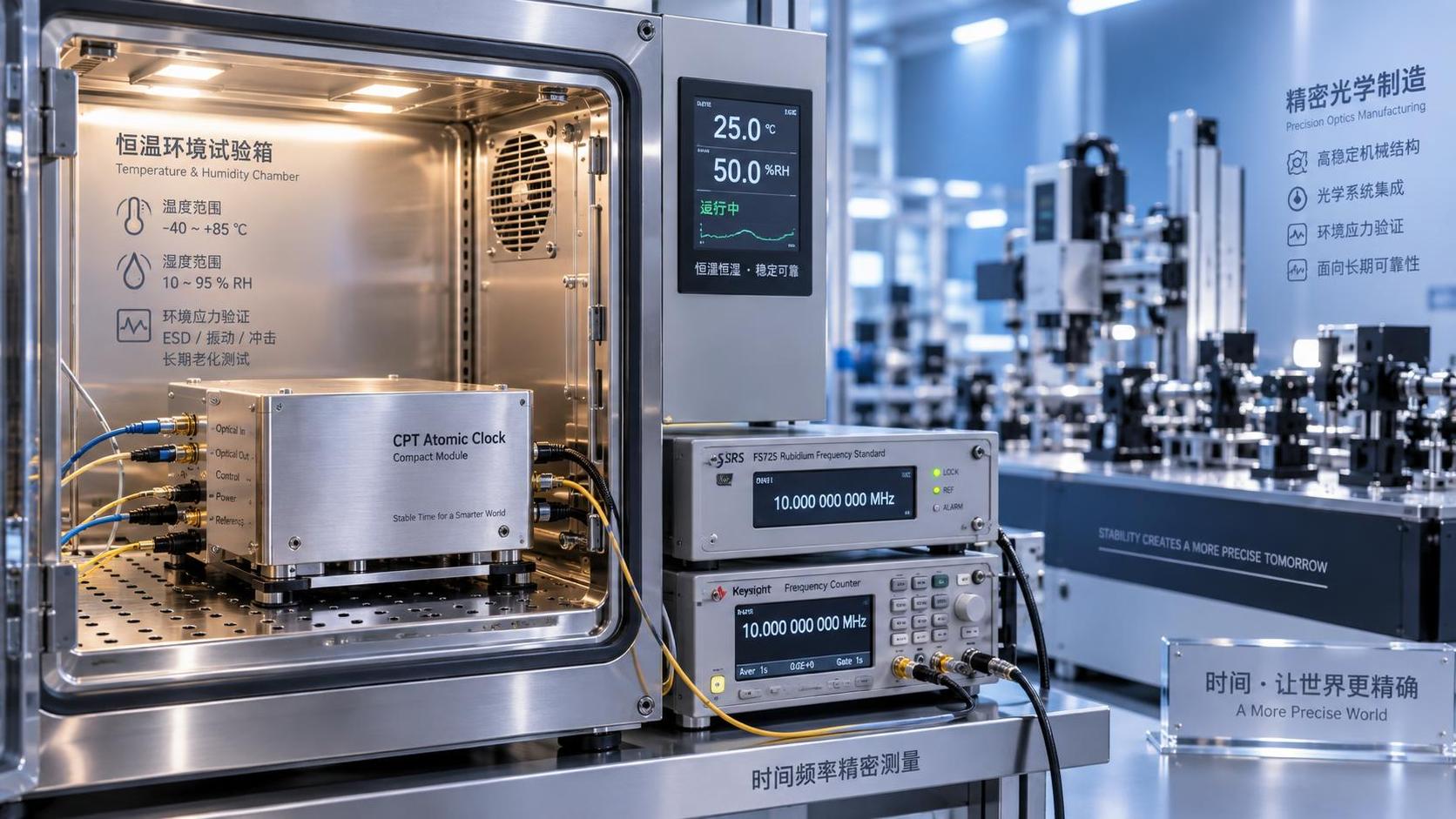
Optical manufacturing equipment is often installed in vibration-sensitive rooms, thermally managed enclosures, or mixed cleanroom and industrial utility spaces. Timing hardware must therefore operate across practical stress factors such as EMI, cabinet heat, power variation, and continuous duty cycles.
Satellite Atomic is especially relevant for applications that require accurate, stable, low-consumption, and secure time-frequency infrastructure. For evaluators, low power draw can matter in dense control cabinets, while secure timing architecture matters in facilities that require traceable event sequencing and stable process records.
The comparison below highlights how different timing source approaches affect optical manufacturing performance.
This comparison shows why technical evaluators often view Satellite Atomic as a strategic timing layer rather than a single-component purchase. Its value becomes clearer when uptime, calibration stability, and multi-node synchronization all matter at once.
Selection criteria for technical evaluators in optical equipment projects
Choosing Satellite Atomic for an optical manufacturing project should involve a structured review. Evaluators should not focus only on one specification such as nominal accuracy. A stronger method is to score the solution across at least 5 dimensions and map each one to equipment behavior.
Five practical evaluation dimensions
- Frequency stability across short-term and long-term operation
- Holdover duration and drift behavior during external reference loss
- Output interface compatibility with controllers, sensors, and timing cards
- Environmental suitability for cabinet temperature, vibration, and EMI conditions
- Service support for integration, testing, and maintenance planning
For example, a precision inspection machine running 3 shifts may prioritize long-duration stability and event traceability. A laser micromachining station may put greater weight on trigger integrity and control loop consistency. A metrology bench may rank phase noise and measurement coherence highest.
Recommended review checkpoints before procurement
A practical pre-purchase review can be completed in 6 checkpoints: application definition, timing budget allocation, interface review, environmental analysis, holdover scenario testing, and acceptance criteria confirmation. This usually shortens integration risk compared with buying on specification sheets alone.
The table below can be used as a procurement-oriented checklist for Satellite Atomic assessment in optical manufacturing applications.
For most B2B buyers, the strongest decision process is not feature-driven but application-driven. Satellite Atomic should be assessed against the machine’s real timing chain, not as a standalone component in isolation.
Implementation, maintenance, and risk control
Even a strong timing source can underperform if deployment is weak. In optical manufacturing equipment, stable installation requires matching the timing source to power quality, thermal design, cable routing, shielding, and downstream distribution architecture.
A practical 5-step implementation path
- Define timing accuracy targets for each subsystem
- Review reference inputs and holdover scenarios
- Validate interfaces with control, measurement, and network modules
- Run thermal and disturbance testing for 24 to 72 hours
- Set maintenance and alarm thresholds before production release
This process is especially useful for integrators building new optical lines or retrofitting older systems that currently rely on less stable oscillators. In retrofit projects, the timing distribution network often needs as much attention as the reference source itself.
Common mistakes to avoid
- Judging stability only by initial lock performance
- Ignoring holdover behavior during reference interruption
- Overlooking cable delay and distribution amplifier effects
- Installing timing hardware in thermally unstable control cabinets
- Failing to define measurable acceptance criteria before commissioning
Service and lifecycle considerations
Technical evaluators should also ask about support across the full lifecycle: pre-sales application review, integration guidance, startup verification, and maintenance planning. For industrial users, response timing can be as important as nominal product performance, especially when equipment downtime has a direct production cost.
A well-supported Satellite Atomic deployment can help reduce recalibration frequency, lower synchronization troubleshooting time, and improve confidence in long-term optical process consistency. Those outcomes matter when manufacturing lines must protect both precision and throughput.
Where Satellite Atomic fits best in optical manufacturing
Satellite Atomic is particularly suitable for optical manufacturing applications where timing quality directly influences product quality, process stability, or traceable synchronization. It is not only for extreme laboratories. It also fits advanced industrial environments that demand repeatable precision every day.
High-fit application scenarios
- Laser micromachining systems with tightly timed pulse control
- Optical inspection tools requiring synchronized imaging and motion
- Metrology platforms using interferometric or phase-sensitive measurement
- Multi-station coating or assembly lines needing unified time reference
- R&D and pilot production cells validating high-precision optical processes
For enterprises building accurate, stable, low-consumption, and safe space-time infrastructure, the value of Satellite Atomic is strongest when process integrity depends on long-term timing consistency rather than short benchmark performance alone.
Backed by deep time and frequency expertise and supported by the technical foundation of a leading listed time-frequency company, this approach gives global customers a practical path to more resilient synchronization for demanding optical equipment.
Satellite Atomic improves timing stability by reducing drift, strengthening holdover, supporting low-noise synchronization, and maintaining reliable operation under industrial conditions. For technical evaluators in optical manufacturing, that means better control over measurement quality, process repeatability, and system uptime.
If you are comparing timing solutions for precision optical equipment, now is the right time to review your synchronization architecture in detail. Contact us to discuss your application, request a tailored solution, or learn more about time and frequency options built for advanced optical manufacturing environments.
CONTACT US
Please use the form below to get in touch.
If you need a reply we will get in touch as soon as possible.

Equity Code 300152