


Equity Code 300152
RELATED
 Rubidium Atomic Clock Performance Metrics: What Technical Buyers Need to Know2026-02-28
- Case Study: Implementing Optical Pump Cesium Frequency Standards in Aerospace Applications2026-02-02
- Latest Innovations in Optical Pump Cesium Frequency Standards: 2023 Industry Updates2026-01-28
- Optical Pump Cesium Frequency Standard Maintenance: Best Practices for Long-Term Reliability2026-01-26



MESSAGE
With the successful commissioning of the new-generation "Beidou" satellite time synchronization system in multiple substations across the State Grid, a key technological breakthrough has been achieved in China's smart grid construction. This new time synchronization solution, centered on the "Beidou Satellite Navigation and Positioning System" and integrated with precision timing technology from atomic clocks, is becoming a critical infrastructure supporting the digital and intelligent upgrading of the power grid.
High-Precision Time Synchronization: The "Neural Pulse" of Smart Grids
In modern power systems, high-precision and secure time synchronization serves as a fundamental requirement for core operations such as relay protection, fault location, and new energy grid integration. Whether enabling millisecond-level rapid response to grid faults or microsecond-level coordination of distributed energy control, these rely on a unified "time reference" across the entire grid. The State Grid’s ongoing overhaul and technical upgrade of time synchronization devices cover hundreds of 110kV substations, ultimately aiming to achieve full integration of "Beidou Time" and end the traditional system’s single dependence on GPS signals.
Atomic Clock Technology: Building an Independent and Controllable Time Reference
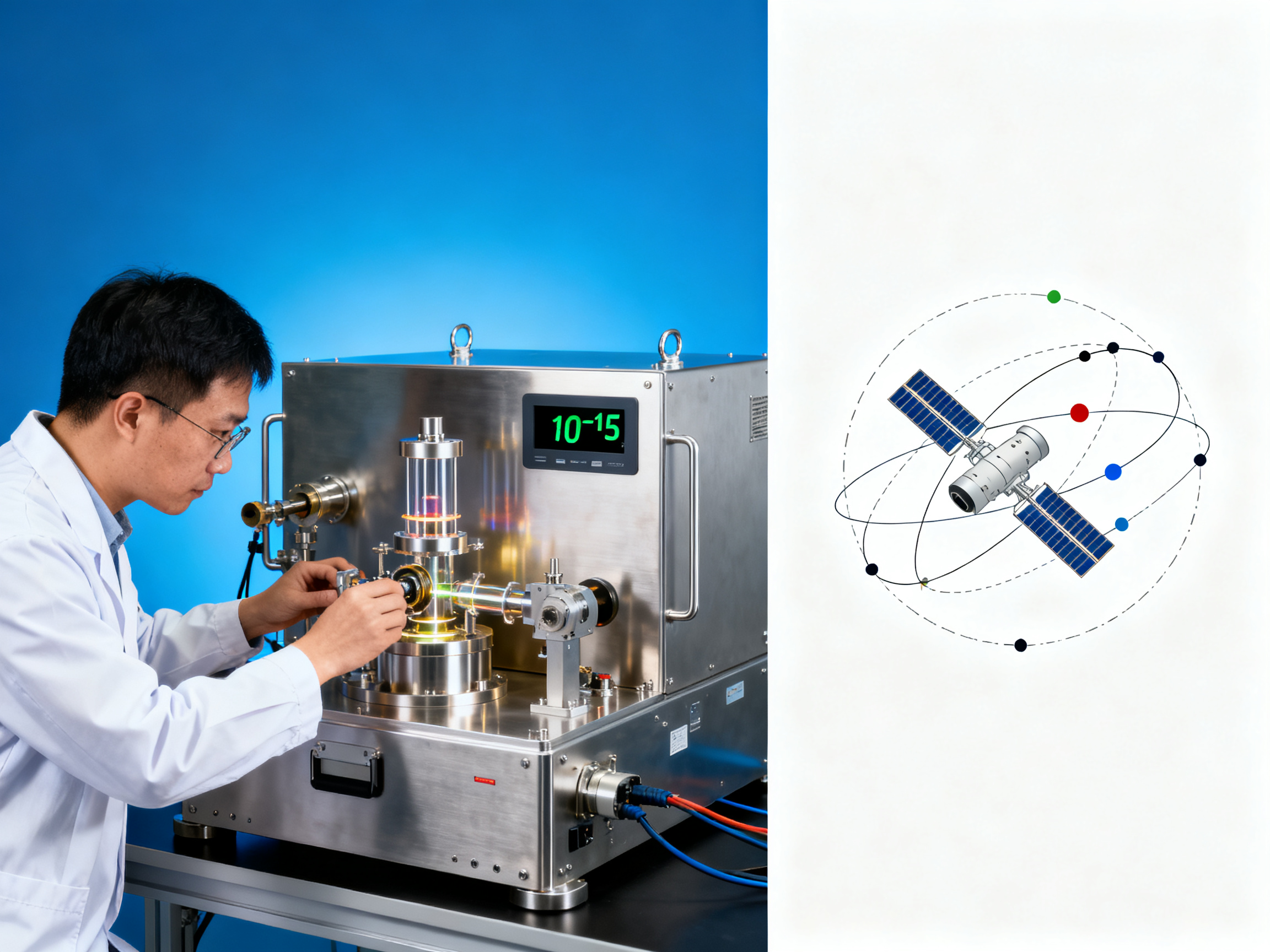
The newly deployed time synchronization devices incorporate rubidium atomic clocks as their core timing units. As high-precision frequency standard devices, rubidium atomic clocks leverage the transition between hyperfine energy levels in the ground state of rubidium atoms (with an inherent frequency of 6834.682614MHz), locking frequencies through "optical pumping-microwave resonance" technology. Their short-term stability reaches the order of 10⁻¹², equivalent to an error of less than 10 nanoseconds per day. In the system, atomic clocks perform two key functions:
- Local Reference Clock: As an independent timing module, they maintain high-precision time output with ultra-stability during temporary satellite signal outages or interference, ensuring substation equipment remains time-synchronized in complex electromagnetic environments;
- Signal Calibration Core: Through a "phase-locked loop-servo circuit" closed-loop system, they continuously receive Beidou signals to calibrate their own frequency, forming a dual-source redundant backup with GPS signals. When a single satellite signal is abnormal, atomic clocks automatically switch to the alternative time source, eliminating the security risks of relying on a single navigation system.
"The atomic clock acts as the 'heart' of the time synchronization system, providing a stable 'heartbeat' reference while continuously 'calibrating its rhythm' based on satellite signals to ensure the grid’s 'time pulse' remains precise and reliable," explained a project technical lead.
Dual-Source Integration: Fortifying a Secure and Reliable Timing Defense
The new system achieves three major technological breakthroughs through a three-level redundancy design combining Beidou+GPS dual-satellite signal reception and rubidium atomic clock local calibration:
- Upgraded Security: Reducing dependence on a single foreign navigation system, it uses Beidou as the primary signal and GPS as a backup. Key substations prioritize pure Beidou timing, meeting the power system’s requirement for "independence and controllability";
- Enhanced Precision: The collaboration between atomic clocks and satellite signals achieves time synchronization accuracy at the microsecond level (≤1μs), satisfying the strict demands of smart grid applications such as distributed energy grid integration and wide-area measurement systems (WAMS);
- Improved Reliability: Even in areas with weak satellite signals (e.g., mountainous regions or urban canyons), the atomic clock’s short-term timing retention capability (error <100 nanoseconds within tens of minutes) ensures continuous operation, enhancing anti-interference capabilities by fivefold compared to traditional solutions.
Toward a "Second-Level Synchronization" Smart Grid Future
With the advancement of the "Double Carbon" goal, the integration of new energy generation, energy storage systems, and electric vehicle charging networks imposes higher demands on grid time synchronization. The application of the "Beidou+Atomic Clock" system not only lays the foundation for current digital substation construction but also supports precise coordination across the entire "source-grid-load-storage" chain in the future. For example, in virtual power plant scheduling, nanosecond-level time synchronization can enable millisecond-level responses from tens of millions of distributed devices, significantly enhancing grid flexibility. In the power IoT, a unified time reference will facilitate accurate correlation of massive sensor data, providing critical support for equipment condition monitoring and fault prediction.
CONTACT US
Please use the form below to get in touch.
If you need a reply we will get in touch as soon as possible.

Equity Code 300152