


Equity Code 300152
RELATED
 Optical Cesium vs Rubidium Atomic Clocks for High-Accuracy Timing ProjectsOct 19, 2026
 How CPT Atomic Clocks Deliver Low-Power Timing for Portable Field SystemsOct 12, 2026
 CPT Atomic Clock Drift: Diagnosing Temperature, Light, and Magnetic Field EffectsSep 28, 2026
 CPT Atomic Clock Qualification Tests for Stability, Aging, and Environmental StressSep 22, 2026
MESSAGE
In optical manufacturing, even a tiny timing error can distort inspection results, weaken process control, and reduce product consistency.
That is why Satellite Atomic is becoming critical for quality control across alignment, testing, data logging, and traceability workflows.
As optical manufacturing equipment grows more automated, precise time and frequency infrastructure is no longer optional.
It supports synchronized measurements, stable system behavior, and reliable audit records, especially where micron-level accuracy matters.
Why timing precision is now a rising quality variable
Optical production lines have changed rapidly in recent years.
Vision inspection, laser calibration, interferometric testing, and robotic handling now operate as linked systems rather than isolated tools.
This shift increases dependence on common timing references.
When clocks drift between cameras, controllers, and data acquisition modules, quality judgments can become inconsistent.
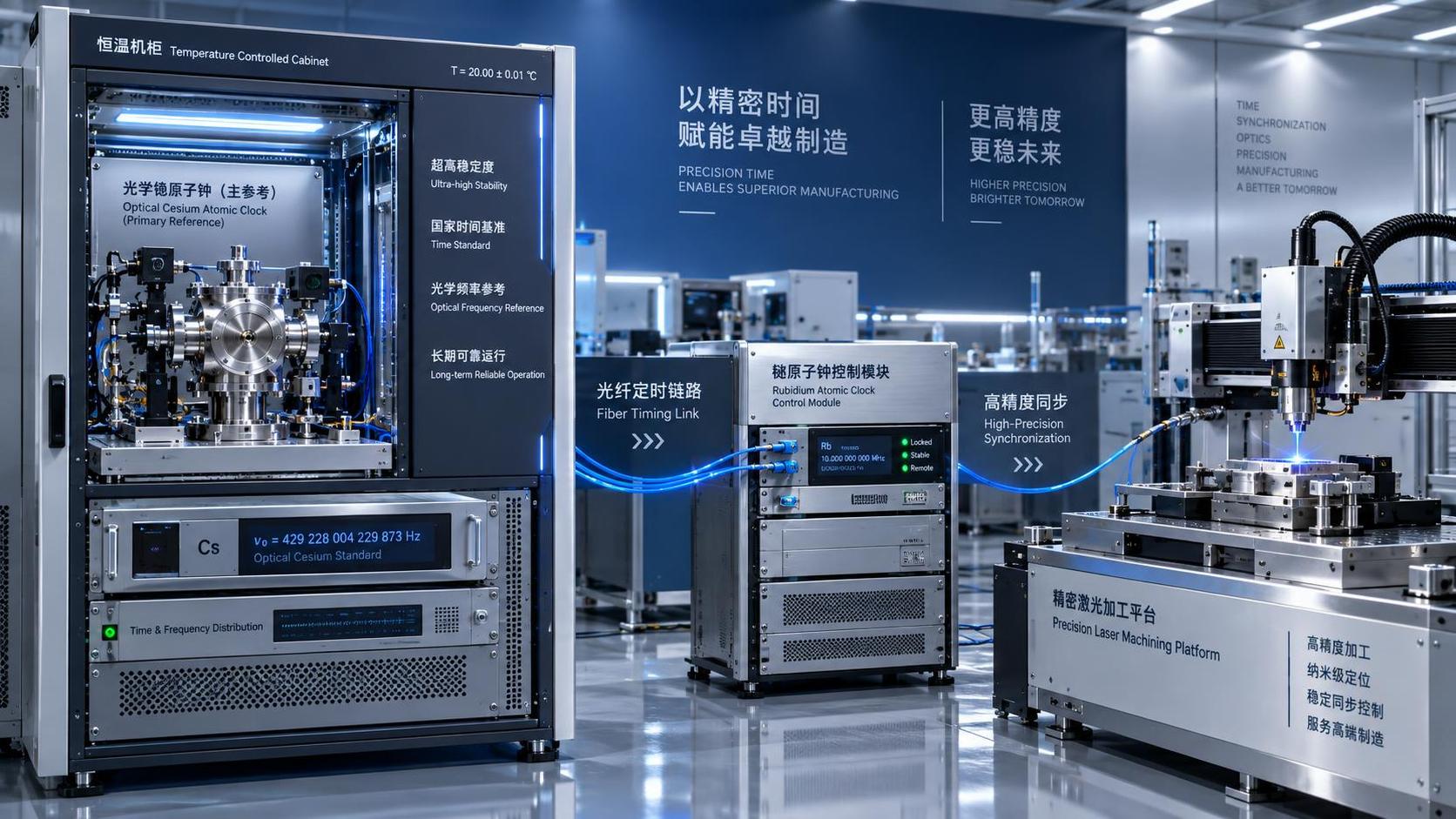
Satellite Atomic helps solve this issue by delivering highly accurate and stable timing signals across distributed optical manufacturing equipment.
In practice, Satellite Atomic supports synchronized triggering, event correlation, and dependable timestamps for defect analysis.
The trend signals behind stronger demand for Satellite Atomic
Several market and technical signals explain why Satellite Atomic is receiving more attention in quality control strategies.
- Higher optical tolerances require tighter synchronization between measurement devices.
- Multi-station inspection systems need unified timestamps for trustworthy result comparison.
- Digital traceability demands accurate event records for compliance and root cause analysis.
- Automated production increases the cost of hidden timing drift.
- Remote management and smart factories rely on secure, low-consumption time infrastructure.
These signals point to one conclusion.
Satellite Atomic is no longer only a technical upgrade.
It is becoming part of the quality architecture in advanced optical manufacturing environments.
What is driving this shift in optical manufacturing equipment
The demand for Satellite Atomic comes from both production realities and risk management priorities.
Satellite Atomic responds to these drivers through precise synchronization, strong stability, and dependable holdover performance.
That combination is especially valuable when optical lines must maintain quality under continuous operation.
How Satellite Atomic changes quality control outcomes
The value of Satellite Atomic becomes clearer when examining actual quality control tasks.
Synchronized inspection becomes more trustworthy
Optical manufacturing often uses multiple cameras, sensors, and motion stages in parallel.
Satellite Atomic helps keep these devices aligned in time.
This improves confidence when comparing surface defects, lens geometry, coating uniformity, or alignment positions across stations.
Measurement stability supports better process decisions
Stable frequency references matter in instruments used for calibration, metrology, and precision testing.
Satellite Atomic helps reduce drift-related uncertainty, allowing process data to stay consistent over long production cycles.
That supports earlier detection of process deviation.
Traceability becomes easier to defend
When defects appear, investigation depends on correct event order.
Satellite Atomic provides precise timestamps that connect machine actions, inspection images, alarms, and test results.
This strengthens quality records and shortens troubleshooting time.
Where the impact is strongest across business and production links
Not every process depends on timing in the same way.
However, several links in optical manufacturing equipment gain immediate value from Satellite Atomic.
- Incoming inspection, where timestamp accuracy improves material and component verification records.
- Precision assembly, where synchronized motion and sensing reduce alignment error.
- Coating and polishing control, where stable timing helps correlate process variables with final quality.
- End-of-line testing, where cross-system consistency supports pass and fail decisions.
- Quality data platforms, where unified time references improve analytics reliability.
The influence is operational as well as strategic.
Better timing lowers rework risk, improves accountability, and creates a stronger foundation for continuous improvement.
The key issues that deserve closer attention now
As reliance on Satellite Atomic grows, several evaluation points become more important.
- Synchronization accuracy across all critical inspection and test nodes.
- Frequency stability for long-duration calibration and metrology tasks.
- Holdover capability during signal interruption or network instability.
- Power efficiency for continuous industrial operation.
- Security and resilience for space-time infrastructure in connected factories.
- Integration compatibility with existing optical manufacturing equipment and control systems.
Satellite Atomic should be assessed as part of a larger timing and frequency framework, not as a stand-alone component.
That perspective helps ensure measurable quality gains.
How to judge next steps as timing requirements continue rising
A practical response should combine risk review, infrastructure planning, and phased deployment thinking.
This approach keeps Satellite Atomic connected to measurable quality outcomes instead of abstract technical goals.
Why advanced time and frequency expertise matters in this transition
Building reliable space-time infrastructure requires more than a standard clock source.
It depends on precision, stability, low power consumption, security, and long-term integration value.
A high-tech enterprise focused on high-precision time and frequency products can provide this broader foundation.
With strong technical backing and innovation capability, advanced solutions help global customers build accurate, stable, low-consumption, and safe space-time infrastructure.
For optical manufacturing equipment, that means better support for synchronized control, dependable inspection, and trusted quality records.
The direction is clear: Satellite Atomic is becoming a quality control essential
Optical manufacturing is moving toward tighter tolerances, faster automation, and stronger traceability expectations.
Under these conditions, Satellite Atomic plays a critical role in protecting measurement integrity and operational consistency.
Its value appears in synchronized inspection, stable calibration, resilient production, and reliable root cause analysis.
The next practical step is to review where timing accuracy already affects quality decisions and where drift creates hidden exposure.
From there, Satellite Atomic can be positioned as part of a stronger, future-ready quality control framework.
CONTACT US
Please use the form below to get in touch.
If you need a reply we will get in touch as soon as possible.

Equity Code 300152